The Truth About Buying A Gun
I originally wrote this piece back in 2022, but never published it for whatever reason. I’m seeing a fair amount of palaver about how easy it is to buy guns in the media again, so I dusted it off and updated it a bit.
A lot has been said about how easy it is for someone to buy a gun. Unfortunately for the anti-gunners, very little of it is true. Let’s walk through the process of a gun purchase at a licensed dealer.
The process starts when you walk through the door. The employees start sizing you up, watching your demeanor. They’re looking for anything out of the ordinary, anything that might disqualify you from owning a gun. This process continues as they show you the various firearms.
Depending on state laws and the dealer’s specific policies you may be asked to present some form of identification before you can handle any of the firearms you’re interested in. Some states require a permit for handgun purchases, some states require a Firearms Owner Identification Card. My home state of New York requires a permit to even handle a pistol in a gun shop.
Once you’ve decided on a firearm, it’s time for you to fill out the ATF form 4473 firearms transaction record. This 6 page form is required for every firearms transfer at a federally licensed dealer. The dealer starts by filling in all the pertinent firearm information including the serial number, type, manufacturer and caliber of the firearm. Then it’s your turn. The information you supply will be used to run a background check. Be sure to input all the information correctly. Errors here can cause issues, including denial of sales.
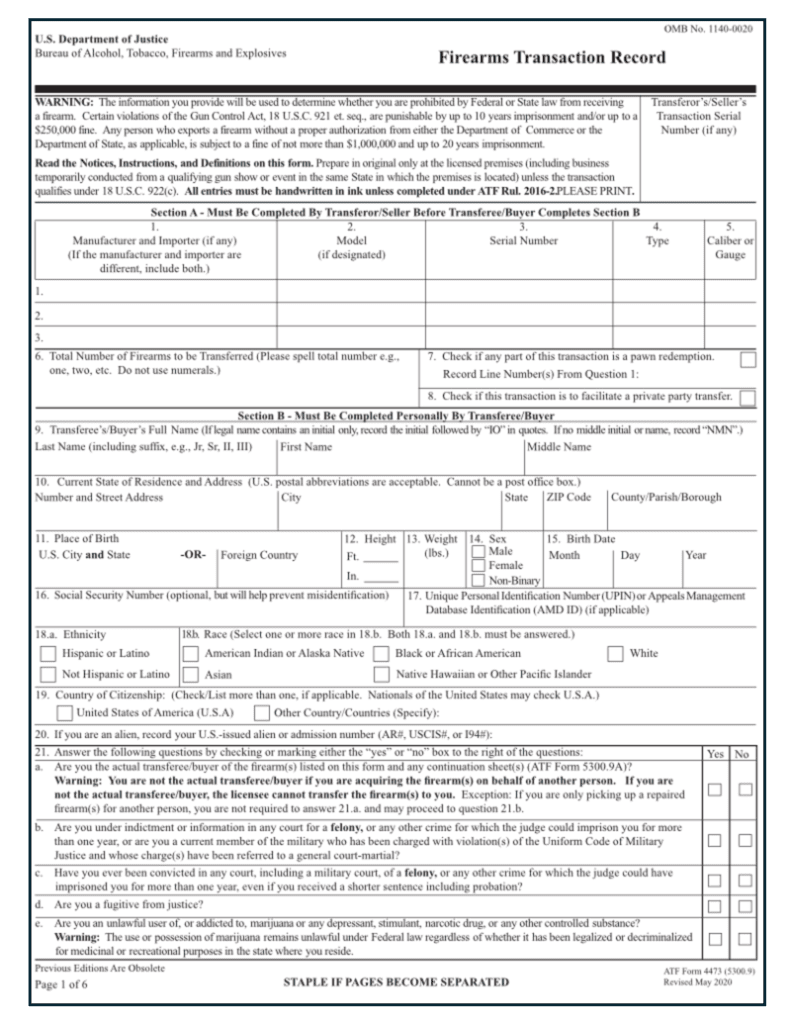
I used the paper form as an exemplar. Most FFLs are using some sort of computerized system these days. The form is the same, just in a PDF or similar fillable format on a screen rather than the paper form of the past. In addition to the expected identity questions, there is a questionnaire portion that asks the following questions:
- Actual Buyer / Straw Purchase (21.a): Asking if you are the actual transferee/buyer of the firearm(s) (answering “no” if you are buying it on behalf of someone else, unless it is a bonafide gift).
- Intent to Transfer to Prohibited Persons (21.b): Asking if you intend to sell or dispose of the firearm or ammunition to a prohibited person.
- Intent for Felonies or Terrorism (21.c): Asking if you intend to dispose of the firearm/ammunition in furtherance of a felony, drug trafficking offense, or federal crime of terrorism.
- Felony Convictions: Whether you have been convicted in any court of a felony or any other crime punishable by imprisonment for more than one year.
- Fugitive from Justice: Whether you are a fugitive from justice.
- Unlawful Drug Use / Marijuana: Whether you are an unlawful user of, or addicted to, marijuana or any depressant, stimulant, narcotic drug, or other controlled substance (note: federal law still prohibits marijuana users, even if state-legal).
- Mental Adjudication / Commitment: Whether you have been adjudicated as a mental defective or committed to a mental institution.
- Discharge Status: Whether you have been discharged from the Armed Forces under dishonorable conditions.
- Restraining Orders / Domestic Violence: Whether you are subject to a court order restraining you from harassing, stalking, or threatening an intimate partner or child, or if you have been convicted of a misdemeanor crime of domestic violence.
- Citizenship / Renunciation / Visa Status: Questions covering renunciation of U.S. citizenship, illegal alien status, or nonimmigrant visa status exceptions.
With the exception of question 21A, if you answer yes to any of the questions you will not be getting a firearm. It was store policy at the shop I worked at to discontinue the process if there was a yes answer to any of the questions from 21B to 21L. Typically, anyone that answered yes went on a blacklist at our location.
After you have filled out your portion of the form, the FFL will compare that information to the information on your governmentally issued ID. Typically, buyers present a drivers license, but there are other acceptable documents. There is an ATF/FBI approved list of identity and domicile documents. It must match the information you put on the form exactly. If your document spells out your full middle name, it needs to be on the form. If you don’t have a middle name or initial, you put NMN (No Middle Name) in the field on the paper form, electronic versions may have different requirements.
If you answered all the questions correctly, the dealer then transmits that information to the NICS (National Instant Criminal Background Check System) facility or the state equivalent. There the FBI or state will run your data through a database of prohibited persons. If you are not on that list you will get a proceed. If the FBI decides they need more time to research you, or it is an extremely high volume day, you may get a delay. If you are on the prohibited persons list, you will be denied.
Currently, there are 17 states that are Full Point-of-Contact States. These states process all firearm background checks through a state agency or state police database rather than routing them directly to the FBI’s NICS. California, Colorado, Connecticut, Florida, Hawaii, Illinois, Maryland, New Jersey, New York, Oregon, Pennsylvania, Rhode Island, Tennessee, Utah, Virginia, Washington and New Hampshire all conduct their own checks if only for certain categories of firearms.
Some states have a permit/licensure schemes that allows some individuals to bypass the check. Purchasers in those states will still have to fill out a 4473. Alabama, Alaska, Arizona, Arkansas, Georgia, Hawaii, Idaho, Indiana, Iowa, Kansas, Kentucky, Louisiana, Michigan, Mississippi, Missouri, Montana, Nebraska, Nevada, North Carolina, North Dakota, Ohio, Oklahoma, Puerto Rico, South Carolina, South Dakota, Texas, Utah, West Virginia, Wisconsin and Wyoming all have Brady Act qualifying alternative permits/licences that allow eligible buyers to bypass a separate NICS check when purchasing a firearm from a licensed dealer, provided the permit is valid, unexpired, and issued within the last five years
Keep in mind, if the dealer decides at any point during the transaction that you shouldn’t have a gun, they can deny the sale. In my time as an employee of a dealer, I refused several sales based on a bad feeling or something the buyer said. My former employer encouraged us to be discriminating about who we sold to. Most FFLs are the same, it can will affect their license if they knowingly sell to someone who has bad intent.
All told, if everything goes right it typically takes half an hour to complete your portion of the form. The check itself can be instant or it can take days, depending on how busy the NICS center is at the time. The quickest I ever completed a gun purchase at an FFL was about 45 minutes. And that was with me knowing the gun I wanted and the guys I was buying from. From the other side of the counter, the quickest I’ve processed is about an hour, but I have waited on a proceed for as long as 10 days. (Here in NY, prior to them becoming a POC state, a proceed was required to complete a transfer. In most states a transfer can be completed in 10 days without one per federal law.) A background check is valid for 30 days.
So, Next time you hear someone whinging about how easy it is to buy a gun, you’ll know better and be armed with the knowledge to dispute it with them.