Saturday Morning Poetry Slam
Most of you know your beloved editor is a poemtry fan. This time of year, between the Gunpowder Plot and Armistice Day, the art form comes to the fore for him.
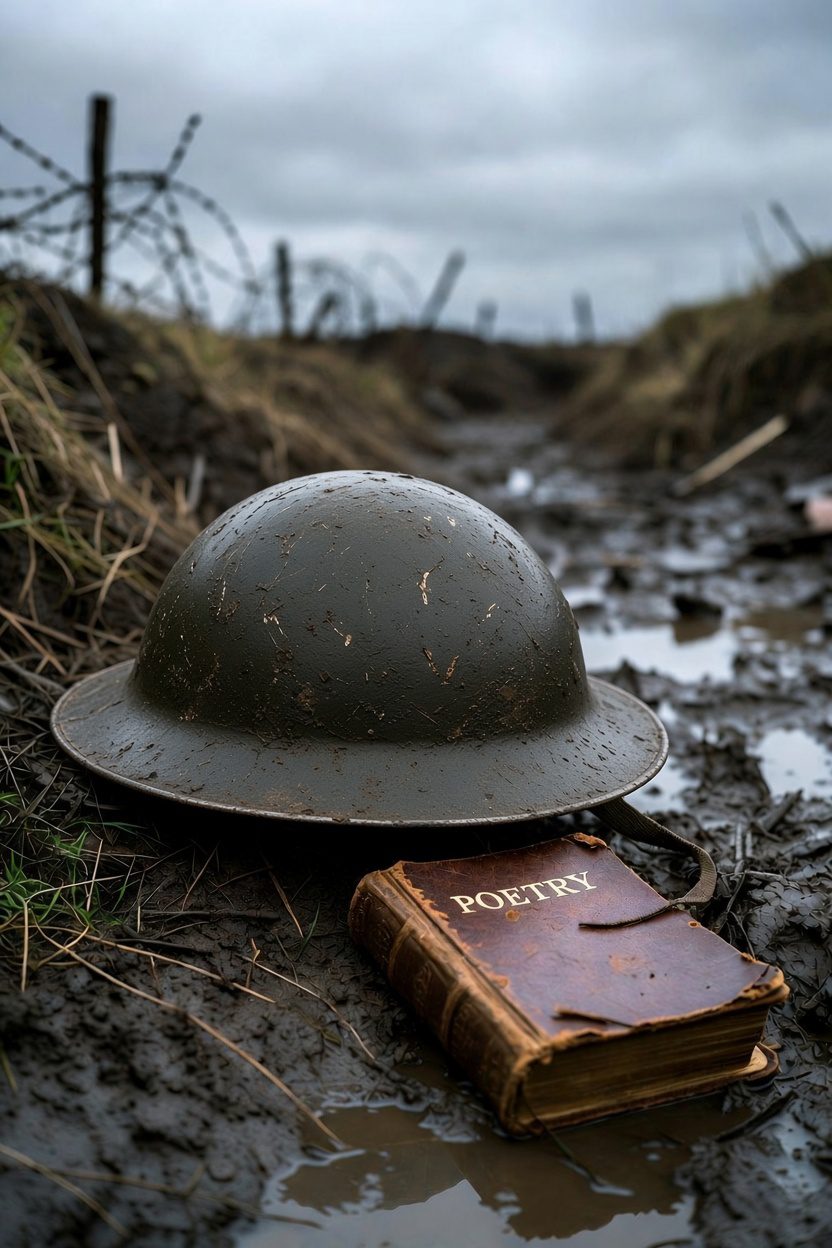
Much of this editor’s love for poetry comes from an early introduction to the writings of the WWI combat poets like Wilfred Owen, Siegfried Sassoon, Rupert Brooke and John McCrae. The word pictures they painted inflamed the imagination – and the heart – of the younger version of this editor.
If I should die, think only this of me:
The soldier
That there’s some corner of a foreign field
That is for ever England. There shall be
In that rich earth a richer dust concealed;
A dust whom England bore, shaped, made aware,
Gave, once, her flowers to love, her ways to roam,
A body of England’s, breathing English air,
Washed by the rivers, blest by suns of home.
And think, this heart, all evil shed away,
A pulse in the eternal mind, no less
Gives somewhere back the thoughts by England
given;
Her sights and sounds; dreams happy as her day;
And laughter, learnt of friends; and gentleness,
In hearts at peace, under an English heaven.
Rupert Brooke
Brooke participated in the defense of Antwerp in 1914. He was then transferred to the Gallipoli front. He died of sepsis on a French hospital ship just outside the Dardanelles.
Even those who did not serve like GK Chesterton, Carol Ann Duffy and Elanor Farjeon wrote memorable stanzas about the war.
My thought shall never be that you are dead:
Reported Missing
Who laughed so lately in this quiet place.
The dear and deep-eyed humour of that face
Held something ever living, in Death’s stead.
Scornful I hear the flat things they have said
And all their piteous platitudes of pain.
I laugh! I laugh! – For you will come again –
This heart would never beat if you were dead.
The world’s adrowse in twilight hushfulness,
There’s purple lilac in your little room,
And somewhere out beyond the evening gloom
Small boys are culling summer watercress.
Of these familiar things I have no dread
Being so very sure you are not dead.
Anna Gordon Keown
This sonnet is still studied in British schools and is part of the testing for the GCSE.
There were poets in other wars. Harry Morant comes to mind. You may know him as Breaker Morant – yes the one the movie is about. Harry Harbord “Breaker” Morant was an English born Australian horseman, bush balladist and military officer. He served in the 2nd Boer war in South Africa, where he was accused of war crimes. A military tribunal found him and two other members of the Bushveld Carbineers – Lieutenant George Witton and Lieutenant Peter Joseph Handcock – guilty and sentenced them to death by firing squad. The Breaker and Handcock were executed by firing squad in Pretoria on February 27, 1902. Witton had his sentence commuted to life imprisonment. On the eve of his execution, Morant penned this:
In prison cell I sadly sit,
butchered to make a dutchmans holiday
A damned crest-fallen chappie!
And own to you I feel a bit-
A little bit – unhappy!
It really ain’t the place nor time
To reel off rhyming diction –
But yet we’ll write a final rhyme
Whilst waiting cru-ci-fixion!
No matter what “end” they decide –
Quick-lime or “b’iling ile,” sir?
We’ll do our best when crucified
To finish off in style, sir!
But we bequeath a parting tip
For sound advice of such men,
Who come across in transport ship
To polish off the Dutchmen!
If you encounter any Boers
You really must not loot ’em!
And if you wish to leave these shores,
For pity’s sake, DON’T SHOOT ‘EM!!
And if you’d earn a D.S.O.,
Why every British sinner
Should know the proper way to go
Is: “ASK THE BOER TO DINNER!”
Let’s toss a bumper down our throat, –
Before we pass to Heaven,
And toast: “The trim-set petticoat
We leave behind in Devon.”
Harry Harbord “Breaker” Morant
The film does a pretty good job of depicting the events. The fairness of the trial was questioned in contemporaneous reports. While Morant and Handcock admitted to some extrajudicial killings, there seemed to have been an unofficial British policy about not taking prisoners. That evidence was not allowed at the trial. It should be noted that the Boer wars were notably brutal, even for the time. They led to the creation of “concentration camps”. The Brits forcibly rounded up and relocated the Boer residents of large swathes of the veld. Thousands of Boer men, women and especially children died in these camps.
While we’re talking about military and soldier themed poems, we can’t forget about Rudyard Kipling. Many of you will only know him as the author of the Jungle Book and the Disney movies that sprung from that work. (The Jungle Book is less a single coherent narrative and more a collection of colonial India inspired short stories and related poems collected in one volume. I highly recommend it. One of this editor’s favorite short stories – Toomai of the Elephants – comes from The Jungle book as does another fave, Rikki Tikki Tavi.)
He wrote an entire volume of military themed poetry – Barracks Room Ballads. He advocated for Tommy Adkins, the generic nickname for British Army troopers, throughout his life and did so pretty directly in the poem of the same name. This editor however prefers a different poem from that collection:
“What are the bugles blowin’ for?” said Files-on-Parade.
Danny deever
“To turn you out, to turn you out”, the Colour-Sergeant said.
“What makes you look so white, so white?” said Files-on-Parade.
“I’m dreadin’ what I’ve got to watch”, the Colour-Sergeant said.
For they’re hangin’ Danny Deever, you can hear the Dead March play,
The regiment’s in ‘ollow square — they’re hangin’ him to-day;
They’ve taken of his buttons off an’ cut his stripes away,
An’ they’re hangin’ Danny Deever in the mornin’.
“What makes the rear-rank breathe so ‘ard?” said Files-on-Parade.
“It’s bitter cold, it’s bitter cold”, the Colour-Sergeant said.
“What makes that front-rank man fall down?” said Files-on-Parade.
“A touch o’ sun, a touch o’ sun”, the Colour-Sergeant said.
They are hangin’ Danny Deever, they are marchin’ of ‘im round,
They ‘ave ‘alted Danny Deever by ‘is coffin on the ground;
An’ ‘e’ll swing in ‘arf a minute for a sneakin’ shootin’ hound —
O they’re hangin’ Danny Deever in the mornin’!
“‘Is cot was right-‘and cot to mine”, said Files-on-Parade.
“‘E’s sleepin’ out an’ far to-night”, the Colour-Sergeant said.
“I’ve drunk ‘is beer a score o’ times”, said Files-on-Parade.
“‘E’s drinkin’ bitter beer alone”, the Colour-Sergeant said.
They are hangin’ Danny Deever, you must mark ‘im to ‘is place,
For ‘e shot a comrade sleepin’ — you must look ‘im in the face;
Nine ‘undred of ‘is county an’ the regiment’s disgrace,
While they’re hangin’ Danny Deever in the mornin’.
“What’s that so black agin’ the sun?” said Files-on-Parade.
“It’s Danny fightin’ ‘ard for life”, the Colour-Sergeant said.
“What’s that that whimpers over’ead?” said Files-on-Parade.
“It’s Danny’s soul that’s passin’ now”, the Colour-Sergeant said.
For they’re done with Danny Deever, you can ‘ear the quickstep play,
The regiment’s in column, an’ they’re marchin’ us away;
Ho! the young recruits are shakin’, an’ they’ll want their beer to-day,
After hangin’ Danny Deever in the mornin’.
Rudyard Kipling
There is extensive evidence that “Danny Deever” was based on an actual event. The details match those of the execution of Private Flaxman, of the 2nd Battalion, The Leicestershire Regiment, for the wilful murder of a lance-sergeant of the 1st Battalion. The execution took place at Lucknow in India on 10 January 1887. There is no evidence that Rudyard Kipling ever saw this particular military hanging. That he was well informed on the details is borne out by the closeness of his description of events and mood to that given in an eyewitness account.
As the first of Rudyard Kipling’s poems to incorporate the views and the dialect of the ordinary soldier with an almost unimaginable subject matter, “Danny Deever” struck the English reading public as astonishingly and dramatically different. It was widely acclaimed when published and has since been singled out by critics and poets alike as one of Rudyard Kipling’s outstanding works
While Kipling himself never served, he had sufficient pull to secure a spot in the Irish Guards for his extremely near-sighted son Jack. An 18 year old Jack would be killed near Loos Belgium in 1915, shortly after getting to the Front. A devastated Kipling would spend much of the rest of his life on the Imperial Graves Commission trying to find and repatriate British war dead.
So MVAP, got a favorite poem, line of verse or poet? Let us know in the comments.