The Only ‘Forever War’ Is the Culture War
Abe GreenwaldNovember 2026 for Commentary
A decade after the attacks of 9/11, Americans began fretting over our country’s painful involvement in so-called forever wars in Iraq and Afghanistan. This was, at first, a mostly left-liberal phenomenon. But the complaint jumped that aisle and is now also repeated by the non-interventionist right whenever U.S. military action is on the table. And so, after President Donald Trump ordered a military campaign against Iran in February, the bipartisan “forever war” chorus rose up and has not stopped singing ever since. Apparently, “forever,” like many other terms, no longer means what it once meant.
Not only are our forever wars over, but the United States won them. Abroad.
Domestically—no.
So first, abroad. Saddam Hussein is dead. His hideous regime is gone. Iraq is far from a model democracy, but it’s a sovereign country in which competing political parties participate in regular elections. And the leaders in Baghdad haven’t made significant trouble for the U.S. in more than a decade. And yes, we defeated the Taliban, too. In 2001, the United States and its allies deposed them in a matter of weeks. Though they repeatedly tried, the Taliban never again ruled Afghanistan—until 2021, when Joe Biden gave it back to them. This was treated by much of the foreign-policy establishment as proof that the war had been unwinnable, which is an odd conclusion. If you beat a force, spend two decades preventing it from returning, and then voluntarily leave so that it can retake the land you secured, you haven’t learned that victory was impossible; no, you’ve decided to reverse it. Thus, while no American troops were killed in Afghanistan in the 18 months before Biden’s withdrawal, 13 American service members were killed in a single day of the pullout.
As I write this, the Islamic Republic of Iran is being systematically stripped of the powers with which it terrorized the region for decades. Its nuclear infrastructure has been devastated. Its economy is under extraordinary pressure. The United States has tightened financial sanctions, and Iran’s oil trade has been hammered. Its effort to use the Strait of Hormuz as an economic nuke has also proved less decisive than advertised. Gulf oil exports have recovered dramatically as regional producers and shippers adapt to the threat. Iran can still inflict tremendous damage, and the Strait of Hormuz still matters, but the regime is losing. Moreover, there’s little in our mostly non-kinetic and economic victory strategies to suggest that any kind of forever war is in the making.
So Iraq, Afghanistan, and Iran—wars we won that didn’t take “forever.” But here’s the thing: America has been fighting a forever war for the past quarter century. We’ve just misidentified it. It’s the culture. And unlike the wars in Iraq and Afghanistan and Iran, there’s no reason to believe that this one will ever end.
Think back to 2001. We remember it as the year in which history abruptly became foreign policy. Nineteen jihadists flew passenger planes into buildings, and America woke up to a world of terrorist networks, failed states, weapons inspectors, intelligence briefings, and far-off lands that were suddenly matters of life and death.
But another history was beginning at the same time.
In 2001, according to the Pew Research Center, 55 percent of American adults were using the internet. Five years earlier, the figure had been just 22 percent. The online world was becoming the American world. And as it did, it started transforming our relationship not only to information but to reality itself.
The 9/11 attacks provided perfect material for the new medium. Almost immediately, the internet filled with theories about controlled demolitions, advance government knowledge, missiles hitting the Pentagon, Jews being warned to stay home, and the rest. Eventually, the 9/11 “Truth” movement would produce Loose Change, an amateur online documentary that became one of the first great viral conspiracy-theory phenomena of the internet age.
It was the prototype for the epistemological madhouse we inhabit now. You had grainy footage, ominous music, amateur sleuths, mysterious arrows superimposed over photographs, experts of uncertain qualifications. The malcontents watching YouTube at two in the morning believed they had discovered what the CIA, FBI, Pentagon, Congress, media, and an army of structural engineers somehow missed.
As online technology improved, it continued to vandalize the public square. We went on to QAnon, election conspiracies, Covid conspiracies, anti-vaccine conspiracies, and an endless supply of online communities devoted to proving that the thing everyone thinks happened is the one thing that could not possibly have happened.
Finding and choosing a side in this increasingly distorted online reality has been at the heart of our culture war ever since.
Back around the time that al-Qaeda attacked the U.S., Americans were fighting about sexuality. In 2001, Pew found that only 35 percent supported same-sex marriage, while 57 percent opposed it. The battle would consume politics for a decade even if it seemed that public opinion reversed in a flash sometime around 2012, when Barack Obama came out in favor. In any event, the Supreme Court settled the legal question in 2015.
But then something interesting happened. The war didn’t end. It morphed.
The country went from arguing about whether two men could marry to arguing about whether a man could be a woman. Gay marriage had been in large part a demand for entrance into an existing institution. Trans radicalism became a demand that existing categories themselves be abolished. What began as a fight over sexual liberty migrated into schools, sports, medicine, language, bathrooms, children, and finally the meaning of the words “man” and “woman.”
That’s how culture wars progress. There is no Appomattox. One side wins a battle, the terrain shifts, and everyone marches toward the next one.
Battles over race followed a similar path. Affirmative action was already a major national issue at the beginning of the century, particularly in higher education. The University of Michigan cases that would reach the Supreme Court in 2003 were already producing campus battle lines in 2001. Over the subsequent two decades, the vocabulary changed. Affirmative action became diversity, equity, and inclusion. Preferences became anti-racism. The limited question of whether universities could consider race in admissions expanded into an entire ideology holding that every institution must be understood as a racial power structure.
Then came the dark days of 2020 and the death of George Floyd. The old argument over racial preferences joined another old argument over crime and policing and mutated into something far more extravagant. America itself was systemically racist; police departments were engines of white supremacy; public safety was subordinate to racial justice; and enlightened people were expected to embrace the idea of abolishing or defunding the police.
That last one ran into reality quite fast once crime began to spike. In June 2020, according to Pew, 25 percent of Americans supported reducing local police spending. By the following year, that number had fallen to 15 percent, while the share wanting more police spending had jumped from 31 percent to 47 percent. Last year, a Harvard/Caps/Harris poll found that 71 percent of Americans would rather increase police funding than decrease it to fund more social workers.
This is worth remembering, because culture wars aren’t merely stories of inexorable leftward movement. Sometimes conservatives win, but that victory comes at a great cost. The political class can declare policing problematic, academics can publish papers about carceral oppression, and nonprofits can devise softer alternatives to arresting violent criminals. Their views gain purchase. And then neighborhoods fall apart, collapsing all the theories that helped bring about the collapse. Reason occasionally gets a vote.
From my present-day perspective, perhaps the most consequential culture-war event of 2001 occurred just before September 11. Between August 31 and September 8, the United Nations held its World Conference Against Racism in Durban, South Africa. The infamous gathering became consumed by the subject of Israel, and the United States and Israel walked out. The NGO forum descended into anti-Israel and anti-Semitic agitation so naked that even Human Rights Watch later described the conference as plagued by intolerance and animus over Israel. A subsequent State Department report noted that the forum used Holocaust language against Israel and that the final conference declaration singled out Israel for criticism.
Durban ended three days before 9/11. Just as the United States was about to enter a 25-year military confrontation with radical Islam, the weaponry of a very different struggle was being assembled in the respectable institutions of the West. The great innovation was to translate hostility toward Israel and Jews into the language of human rights, anti-racism, anti-colonialism, and social justice.
Israel would not merely be wrong in the way it conducted or enacted this or that policy. It would be a racist, colonialist, genocidal, apartheid state. And the Jew would be steadily recast as white, privileged, and oppressive. With this, anti-Semitism would find its home base inside an ideology supposedly dedicated to protecting minorities from hatred.
Twenty-two years after Durban, Hamas invaded Israel and murdered, raped, tortured, and kidnapped Jews. With the support of activist organizations and foreign governments, American college students responded by setting up encampments. It was Durban on the quad, everywhere. Tents or no tents, it still is.
There was another post-9/11 culture-war development that would go on to feed the current anti-Semitic mania. The United States became fixated on “Islamophobia.” The panic, however, is belied by the fact that, in December 2001, Pew found that Americans’ favorable views of Muslim Americans had actually increased after the attacks, from 45 percent to 59 percent.
Yet “Islamophobia” grew into one of the culture war’s most durable concepts. The country that responded to the murder of 3,000 of its citizens with extraordinary official efforts to distinguish Islam from Islamist terrorism gradually became embarrassed about making the distinction in the other direction—about acknowledging that Islamist terrorism had anything in particular to do with Islam.
That dispute eventually merged with the Israel question, immigration, terrorism, free speech, and the larger Western argument over whether tolerance requires us to refrain from noticing what intolerant people actually believe and do.
And all this was happening while Americans were supposedly preoccupied with their foreign wars when, in point of fact, those wars themselves became absorbed into the culture war. On the left, opposing the Iraq War stopped being merely an argument about strategy, intelligence, or national interest. It became part of a larger indictment of America: militarism, imperialism, racism, Islamophobia, Halliburton, Abu Ghraib, Guantanamo, torture, surveillance, George W. Bush, Dick Cheney, and the whole blood-soaked machinery of American power. It wasn’t until the past few years that a faction of the right would adopt some of this paranoia and mix it with their anti-Jewish suspicions.
Today, the battlefield and the culture war are nearly impossible to separate. When Americans argue about Ukraine, Israel, Iran, Afghanistan, or military spending, they are rarely arguing only about the particular conflict. They’re arguing about America.
Is this country essentially decent or essentially wicked? Is American power a force that generally restrains worse forces, or is it itself the principal danger? Are the costs of maintaining order evidence that the order is corrupt? Do we have obligations to allies? Is deterrence worth paying for before the thing being deterred happens? When Americans die defending an interest abroad, does that prove that the mission mattered or that the mission was criminal?
And herein lies the great deception achieved by the phrase “forever war.” A civilization that intends to survive will always pay for defense. Sometimes the payment is massive. Sometimes the strategy is stupid. Sometimes leaders lie, generals err, intelligence fails, missions creep, and money disappears into projects that should never have existed. None of that changes the basic fact that safety has costs.
The fantasy behind much forever-war rhetoric is that there exists some natural condition called peace in which serious countries can simply decline to participate in history. There isn’t.
You can withdraw from Afghanistan, but the Taliban doesn’t therefore withdraw as well. If you decline to confront Iran, the regime doesn’t decline to build missiles, finance terrorists, pursue nuclear capabilities, and threaten the world.
But the culture war really is forever, because culture is an argument—about how people should live, what they should honor, what they should tolerate, what they owe one another, and what their country means.
Those questions don’t get settled. There are victories and defeats and periods of madness followed by correction. What happened with police defunding in 2020 and 2021 can happen elsewhere.
It may already be happening to liberal media. For decades, a relatively small number of institutions controlled the national conversation. That power has been shattered by podcasts, Substack, X, YouTube, independent websites, and a thousand other sources of information that would have been technologically impossible when the forever wars began. Trust in mass media has meanwhile reached its lowest point in a half-century trend.
Perhaps academia is next.
Universities spent decades becoming more expensive, more ideologically uniform, and more detached from the lives of the people who pay for them. After October 7, the horrors on campus revealed that some of America’s most prestigious schools had managed the extraordinary feat of combining intellectual conformity, administrative cowardice, and anti-Semitism, paid for in part by tuition bills approaching the annual income of an affluent family.
The Trump administration has gone directly after that system, most dramatically by trying to use federal funding as leverage against universities over their handling of anti-Semitism. The universities have fought back in court, and some administration actions have been blocked. But the old arrangement—in which elite universities could take billions from the federal government while regarding accountability as an intrusion upon their autonomy—is under attack.
And there is a looming problem that no court can solve for them. It is hard to believe that 25 years from now, Americans will routinely pay $75,000, $90,000, or $120,000 a year for credentials that don’t produce economic value, intellectual seriousness, or even the ability to distinguish civilization from barbarism. In culture wars, markets get a say.
In addition to the examples of liberal media and radical academia, we’ve recently witnessed the rollback of DEI and broad resistance to the trans movement’s maximalist claims. Bad ideas acquire prestige. Institutions enforce them. Ordinary people become afraid to object. Reality eventually intrudes. Someone objects anyway. Then others discover that they were never alone.
The right question isn’t whether the culture war can be won. It can’t—not permanently. The question is whether the people who have held the commanding heights of American culture for decades can be forced to surrender some territory.
Twenty-five years ago, Americans entered what they came to believe was a forever war against enemies abroad. Those enemies turned out to be beatable. Meanwhile, the arguments that surrounded those wars are still here. So are the arguments over race, sex, crime, Israel, education, religion, speech, national identity, and the meaning of America itself. Some have changed names. Some have changed sides. Some have become nearly unrecognizable.
America wins wars, loses wars, and sometimes merely ends them. But we have no off switch for the culture or its competing discontents. And so we must continue to fight, winning some, losing some, but never going silent, and never putting our dukes down.
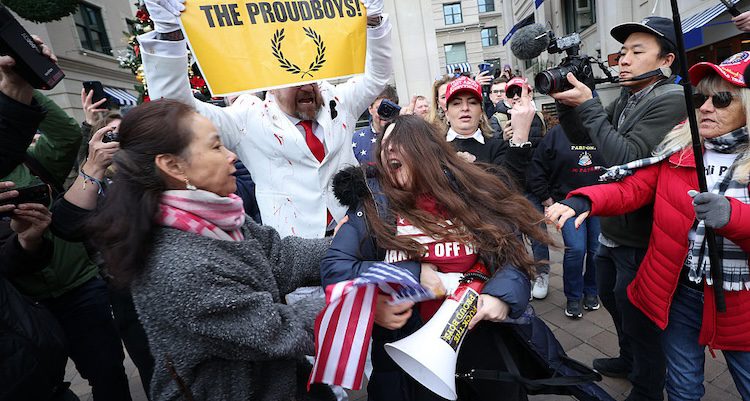
Photo: Win McNamee/Getty Images