The American Revolution… How it all began… Part 8
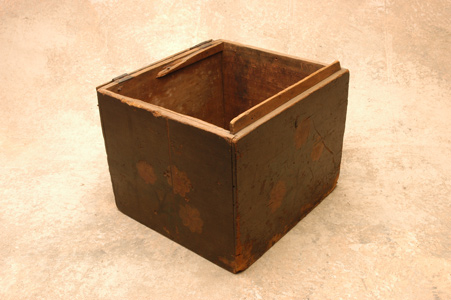
Featured Image: The Robinson half tea chest. It is one of two authenticated surviving tea chests from the Boston Tea Party. It is currently on display at the Boston Tea Party Ships & Museum.
The East India Company had once more fallen into debt and was in danger of default, forcing the English government to come to its rescue once more. Edmond Burke stated that Lord North was seeking to put the company under the umbrella of the Crown, thereby allowing the King to rule without Parliament. This in the eyes of the Americans threatened both the East India Company and the freedom of the Colonies. The Tea Act of 1773 placed a small tax on tea imported into America by the East India Company and was supported by Lord North.
The company reasoned that the repeal of the tax on tea would heal the ailing company and drive the smugglers of other teas from the colonies and restore peace between the government and America. Lord North believed that by giving America cheap tea they would buy tea, tax or no tax. He believed that the tax must be retained for Parliament to retain its authority of the right to tax the colonies. The company was given the right to ship its tea directly to the colonies bypassing the costly regulations that all products bound for the colonies be processed through English ports but the tax on tea was retained.

The East India Company shipped 298 chests of tea to Boston, 257 chests to Charlestown and 698 chests to New York and Philadelphia. Contrary to widely held beliefs by the English, it was not Boston that harbored the most smugglers, but Rhode Island, New York and Philadelphia.
In the eyes of the American patriots, the biggest threat from the tax was the maintenance of an Army in the colonies and a civil list that nullified the colonial assemblies. “What the Parliament could not Fleece from us by Taxes, the Crown will by Monopoly” claimed the merchants of New York. The colonial patriots believed that Lord North was attempting to “take by ruse, what he could not take by storm”. It was believed that once the tea tax had breached American defenses, the King would “enter the Bulwarks of our sacred Liberties, and will never desist, till they have made a Conquest of the whole”!
The dispersal of the East India Company tea was consigned to tea agents appointed by the governors of the colonies. The agents were to see the offloading of the tea but “The Sons of Liberty” paid visits to many of the agents convincing them to renounce their appointment leaving the tea to still be on board the ships. This led to a standoff between the governors and the captains, leaving many of the agents to seek safety on British naval vessels.

Governor Hutchinson believed that the “Sons of Liberty” would allow the tea to be unloaded at the last moment. The patriots came to the conclusion that they had to dispose of the tea before December 17,1773 before it would be seized by customs officials for non-payment of duty and sold to pay the salaries of the governor, Tory judges and customs officials.
The “Sons of Liberty” decided to jettison the tea into Boston Harbor on the night of December 16, 1773. Under the cover of darkness and disguised as Mohawk Indians, they boarded the three vessels carrying the tea and dumped it into Boston Harbor, while the citizens of Boston kept the British Crown officers from being able to identify any of the “Mohawk Indians”.* Years later, George Hewes said that there were several prominent members of the “Sons of Liberty” among the so-called Indians.

The governor of Massachusetts realized the folly of arresting and trying anyone involved in the affair but many of the citizens felt that the wrath of the English government would not fail to punish them as well as the guilty. By contrast, the Whigs called the dumping of the tea a legitimate act of self-defense against tyranny as defined by John Locke.
The “Boston Tea Party” was not the only act of rebellion against the Crown. In New Jersey the tea cargo of the ship Greyhound was burned. In South Carolina several tea chests were thrown into the Cooper River and in New York the tea again was brewed with salt water. The American patriots insisted that tea be forsworn by all Americans in order that NO TAXED TEA be drunk throughout the colonies. As a result of patriotic pressure, tea virtually disappeared from the colonies.
The British government was outraged by the acts of the Boston patriots; what followed was retaliation on a scale not before enacted against the American colonies. The retaliation faced by the colonies would later be called, “The Coercive Acts”.
* Editors note: Whilst searching for illustrations for this piece, I came across an interesting, but somehow obscure, article that stated the Tea Party was blamed on Narragansett Indians rather than the Mohawks as is commonly claimed. This would make sense as the Mohawk homeland was several hundred miles from Boston. The Mohawk were from the eponymous valley in upstate New York and the intervening miles were populated by tribes that were hostile to any native that was part of the Iroquois Confederacy. Meanwhile, the Narragansetts were located in the area between Boston and Rhode Island. Most contemporary local reports referred to the raiders as either indians, natives or Narragansetts. The term Mohawk was used in a single newspaper report and has gained popularity in the intervening years.