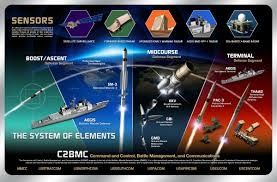
Missile Defense
Editor’s note: This is an older piece – I don’t recall the original pub date, but based on the formatting it was back in the disqus channel days – that I have dusted off and updated in response to a question about the ‘Golden Dome’ that Trump was talking about. It covers all the known* current missile defense systems in the US inventory. Any errata or omissions are mine and mine alone. Some of the graphics used are a bit outdated and do not include data on the NASAMS. This is partially because the NASAMS just came online in the US and partially because the particular manufacturer isn’t chasing publicity like Lockheed. If you would like to see more of this kind of technical writing from me let me know. It can be difficult, especially the research parts, but worthwhile if there is an audience for it.
*(I say known because I have seen reports that the US has some of the Israeli Arrow and David’s Sling interceptors, but I cannot confirm that they are a) operational and b) anything other than test articles.)
Missile defense systems are intended to defend against ballistic missiles fired at the United States, its allies, or its deployed forces. Ballistic missiles, which were developed during World War II, are initially powered by a rocket motor that boosts them high into the air; after that they coast on an arching (ballistic) trajectory, powered only by gravity as they fall to Earth toward their target. Ballistic missiles are very difficult to intercept once fired—their speed, high-altitude flight, and long range mean that developing weapon systems capable of destroying them in flight is extremely challenging. Those same characteristics have also made ballistic missiles a preferred delivery system for nuclear weapons. The difficulty of defending against nuclear-armed ballistic missiles is one of the main reasons that the United States continues to rely heavily on deterrence to protect against nuclear attacks.
Intercontinental ballistic missiles (ICBMs) and the very similar submarine-launched ballistic missiles (SLBMs) present the greatest technical challenges to effective missile defense: Their very long range (between continents) requires extremely powerful engines, which accelerate them to very high speeds and loft them in very high ballistic arcs. Intermediate-range, medium-range, and short-range ballistic missiles are somewhat less challenging because they reach lower maximum speeds and usually fly at lower altitudes.
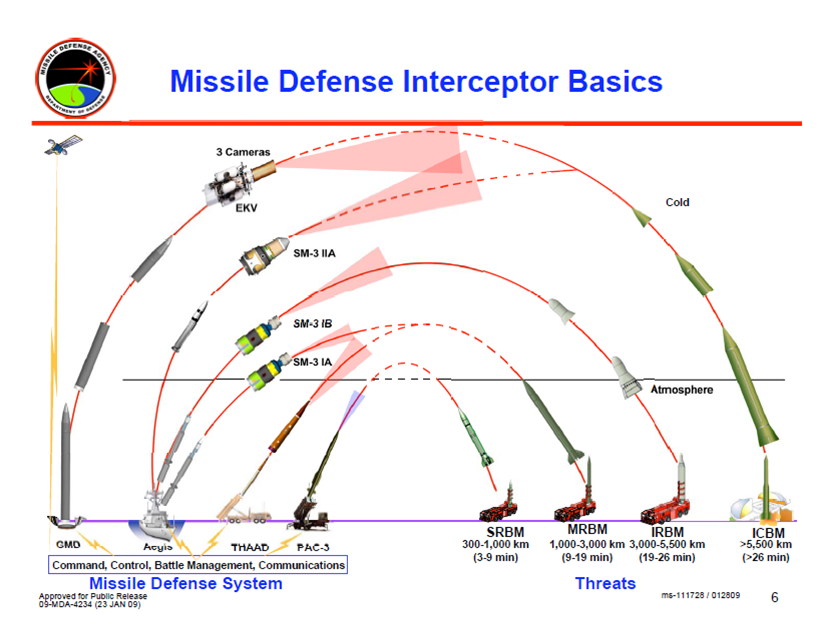
In general, ICBMs and SLBMs are the most costly and difficult weapon systems to develop and are designed to deliver nuclear weapons, meaning that usually only the largest nuclear powers possess them. Short-range ballistic missiles are much less costly and difficult to develop, are fielded by many countries, and are generally armed with conventional explosive payloads rather than nuclear warheads. Medium-range ballistic missiles are more expensive and less plentiful than their short-range counterparts, and intermediate-range ballistic missiles are more costly and less common than medium-range missiles.
The first missile defense systems were developed by the United States and the Soviet Union in the 1960s and 1970s. They were designed to destroy a ballistic missile after its launch by detonating a nuclear warhead in its vicinity. However, because of the undesirability of using nuclear warheads, the United States began in the 1980s to extensively research ways to use conventional explosive or kinetic warheads to destroy ballistic missiles.
Effective missile defense remains highly challenging. As a result, analysts outside DoD have raised a number of concerns about the feasibility of missile defense in general and about the performance of current U.S. systems in particular—especially against an adversary that can field decoy warheads and other countermeasures to confuse defense systems. MDA has faced external criticism of its test programs and their results, and it is difficult to assess how effective the systems that DoD has fielded would be in an actual missile attack.
Even if all of its current systems perform as DoD plans, the GMD system intended to defend U.S. territory against missiles is designed to protect against attacks by very small numbers of long-range ballistic missiles—the sort of attack that might be launched by a so-called rogue state, such as North Korea or Iran. That system is not intended to defend the United States against attacks by large numbers of nuclear-armed missiles.
DoD has four major missile defense systems, which are designed to intercept threatening missiles in midair:
The Ground-Based Midcourse Defense (GMD)
system
The Army operates this system from various land bases, it is designed to protect the United States against long-range ballistic missiles. That system is intended to intercept missiles during the midcourse part of their flight (the phase after a missile’s rocket motor has stopped burning and accelerating the missile but before air resistance from reentry into the atmosphere has begun decelerating it). In that phase, missiles are at their maximum speed and are generally following predictable, parabolic paths.
The system consists of ground-based interceptor missiles and radar which would intercept incoming warheads in space.
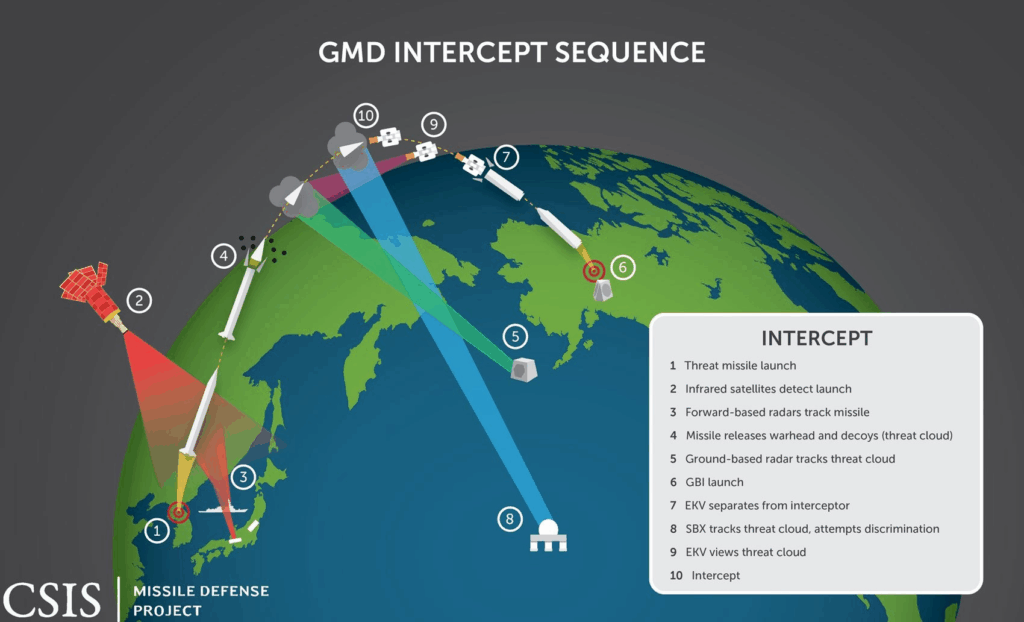
The key sub-systems of the GMD system are:
Exoatmospheric Kill Vehicle (EKV)
Ground-Based Interceptor (GBI) – for every interceptor missile there are a missile silo and a silo interface vault (SIV), which is an underground electronics room adjacent to the silo.
Battle management command, control and communications (BMC3)
Ground-based radars (GBR).
Upgraded early-warning radars (UEWR) (or PAVE PAWS)
Forward-based X band radars (FBXB) such as the sea-based X-band platform and the AN/TPY-2.
Interceptor sites are at Fort Greely, Alaska and Vandenberg Air Force Base, California
The Aegis Ballistic Missile Defense (BMD) system
A midcourse-phase interception system operated by the Navy from cruisers and destroyers, is designed to protect allies and U.S. forces from medium- and intermediate-range ballistic missiles. DoD has developed a land-based variant of the Aegis system called Aegis Ashore, as well as an interceptor capable of targeting missiles during the terminal phase of their flight (when air resistance from reentry has begun decelerating them). Missiles in that phase are very close to their targets, which greatly reduces the time that missile defense systems have to react to them but also allows the use of relatively short-range and lower-cost interceptor missiles.
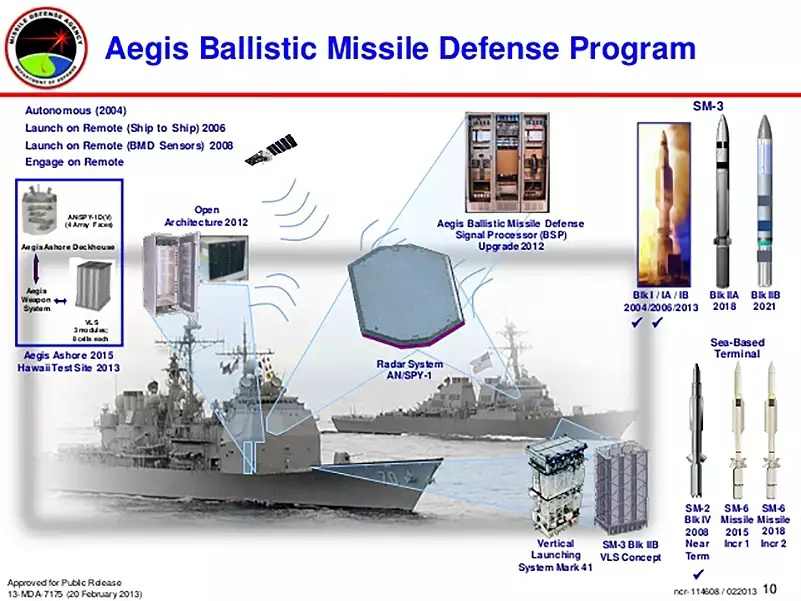
The Aegis system is a multi layered combat system, in addition to ABM defenses the system has the ability to detect, track and target more than 100 targets at distances exceeding 100 nautical miles. The Aegis Combat System is controlled by an advanced, automatic detect-and-track, multi-function three-dimensional passive electronically scanned array radar, the AN/SPY-1.
The computer-based command-and-decision element is the core of the Aegis Combat System. This interface makes the ACS capable of simultaneous operation against almost all kinds of threats. The Aegis Ballistic Missile Defense System (BMD) program is intended to enable the Aegis system to act in a sea-based ballistic missile defense function, to counter short- and medium-range ballistic missiles of the variety typically employed by a number of potential opponent states.
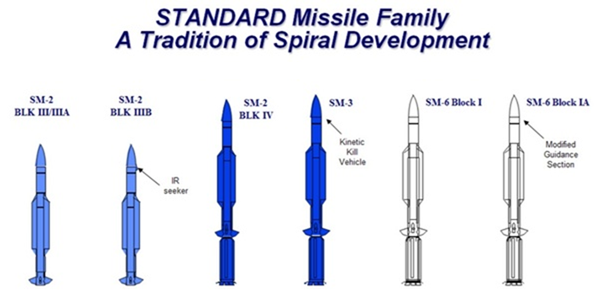
Initially used by the United States Navy, Aegis is now used also by the Japan Maritime Self-Defense Force, Spanish Navy, Royal Norwegian Navy, and Republic of Korea Navy. Over 100 Aegis-equipped ships have been deployed in five navies worldwide. The Royal Australian Navy selected the Aegis system for placement on its new Air Warfare Destroyers, and it is part of NATO’s European missile defence system. The land based AEGIS ashore system is currently deployed to Poland, Romania and Guam. There are plans to expand the number of AEGIS ashore sites in the near future.
Aegis has proved capable of intercepting several types of ballistic missiles in combat. Both the USS Stockdale and the USS O’Kane have successfully intercepted multiple Houthi-fired missiles in the Red Sea. The USS Cole and the USS Bulkeley successfully intercepted Iranian IRBMs fired at Israel. All four ships are Arleigh Burke class Aegis destroyers.
.
.
.
.
The Terminal High Altitude Area Defense (THAAD) system
A terminal-phase interception system operated by the Army from mobile launchers, is designed to intercept short- and medium-range ballistic missiles as they near their targets.
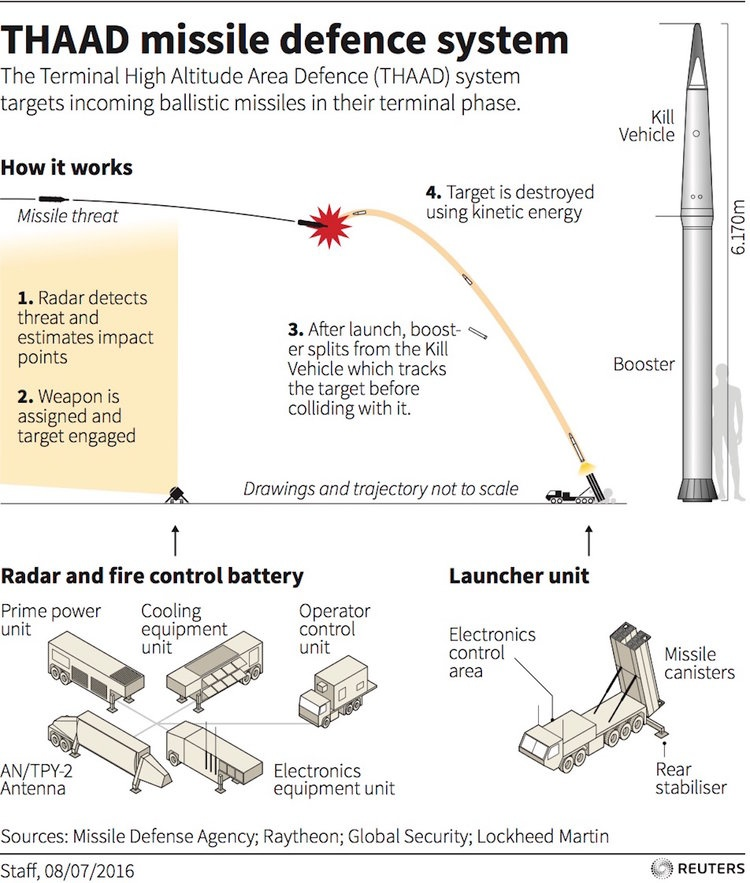
THAAD was developed after the experience of Iraq’s Scud missile attacks during the Gulf War in 1991. The THAAD interceptor carries no warhead, but relies on its kinetic energy of impact to destroy the incoming missile. A kinetic energy hit minimizes the risk of exploding conventional warhead ballistic missiles, and the warhead of nuclear tipped ballistic missiles will not detonate on a kinetic energy hit.
THAAD was originally scheduled for deployment in 2012, but initial deployment took place in May 2008. THAAD has been successfully deployed in Israel, the United Arab Emirates, Turkey, and South Korea. The first combat test of THAAD interceptors occurred over Israel during the Iranian missile attacks in 2024. The record of the THAAD interceptors has been mixed so far, with both successes and failures recorded. The radar and targeting system had been previously tested when it was integrated into the Iron Dome system in 2017.
.
.
.
.
The Patriot Advanced Capability 3 (PAC-3) system
A terminal-phase interception system operated by the Army from mobile launchers, is similar to THAAD but is better suited to intercepting smaller short-range ballistic missiles. It can also intercept cruise missiles and aircraft. The AN/MPQ-53 at the heart of the system is known as the “Phased array Tracking Radar to Intercept on Target” which is a backronym for PATRIOT.
The PAC-3 upgrade is a significant upgrade to nearly every aspect of the system. Due to miniaturization, a single canister can hold four PAC-3 missiles (as opposed to one PAC-2 missile per canister). The PAC-3 missile is also more maneuverable than previous variants, due to 180 tiny pulse solid propellant rocket motors mounted in the forebody of the missile (called Attitude Control Motors, or ACMs) which serve to fine align the missile trajectory with its target to achieve hit-to-kill capability.
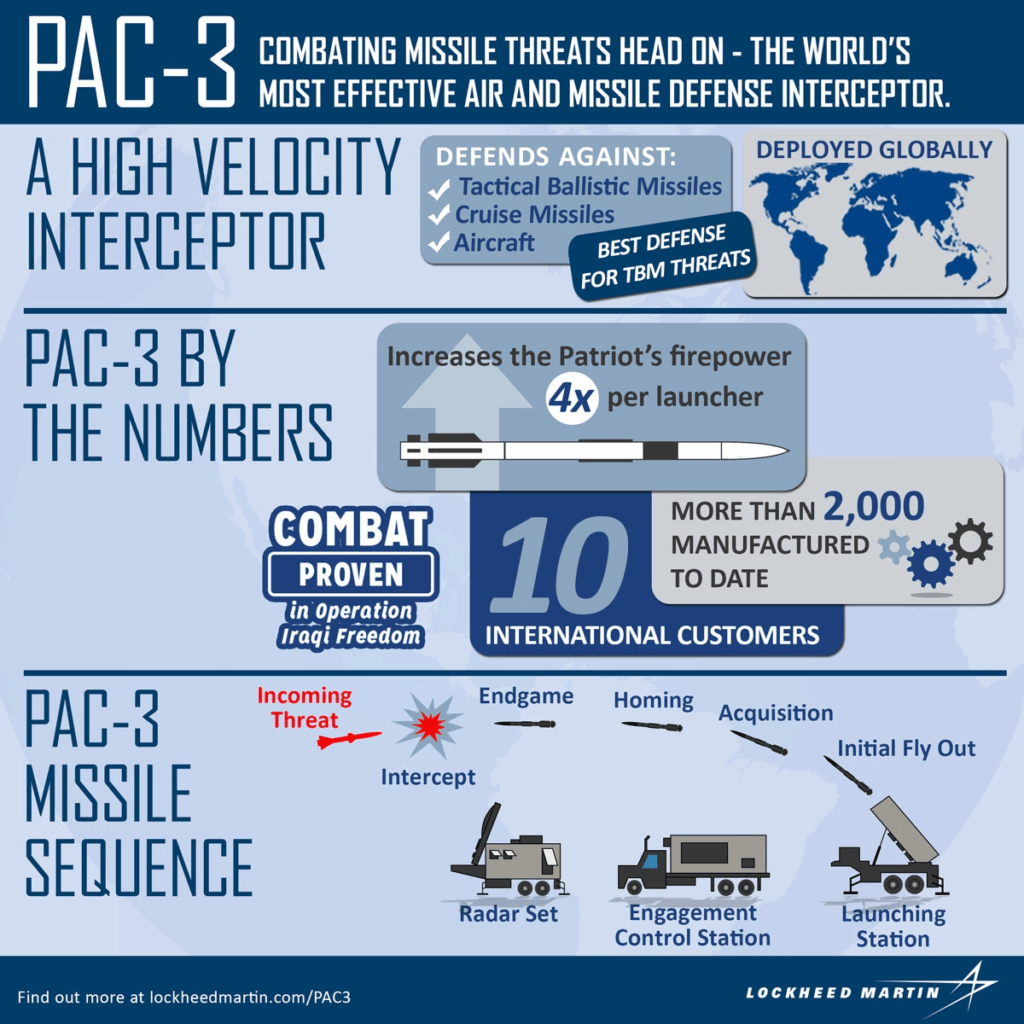
However, the most significant upgrade to the PAC-3 missile is the addition of a Ka band active radar seeker. This allows the missile to drop its uplink to the system and acquire its target itself in the terminal phase of its intercept, which improves the reaction time of the missile against a fast-moving ballistic missile target. The PAC-3 missile is accurate enough to select, target, and home in on the warhead portion of an inbound ballistic missile. The active radar also gives the warhead a “hit-to-kill” (kinetic kill vehicle) capability that completely eliminates the need for a traditional proximity-fused warhead. However, the missile still has a small explosive warhead, called Lethality Enhancer, a warhead which launches 24 low-speed tungsten fragments in radial direction to make the missile cross-section greater and enhance the kill probability. This greatly increases the lethality against ballistic missiles of all types.
Patriot systems have been sold to Germany, Greece, Israel, Japan, Kuwait, the Netherlands, Poland, Qatar, Romania, South Korea, Saudi Arabia, Spain, Sweden, Taiwan, the United Arab Emirates, and Ukraine. Poland hosts training rotations of a battery of U.S. Patriot launchers. South Korea purchased their Patriot systems after North Korea test-launched ballistic missiles to the Sea of Japan and proceeded with underground nuclear testing in 2006. There are several Patriot batteries deployed in Ukraine where they have been very successful in intercepting Russian SRBMs, cruise missiles and drones. The IDF has successfully integrated the PAC3 system into the Iron Dome and has seen multiple successful interceptions.
.
.
.
.
.
NASAMS
NASAMS, or the National (or Norwegian) Advanced Surface-to-Air Missile System, is a joint US/Norwegian system developed by RTX (formerly Raytheon) and Kongsberg Defense. It uses an upgraded AIM-120 AMRAAM (Advanced Medium Range Air-to-Air Missile) as the interceptor. It is the first time that particular missile has been used in a ground launch capacity.
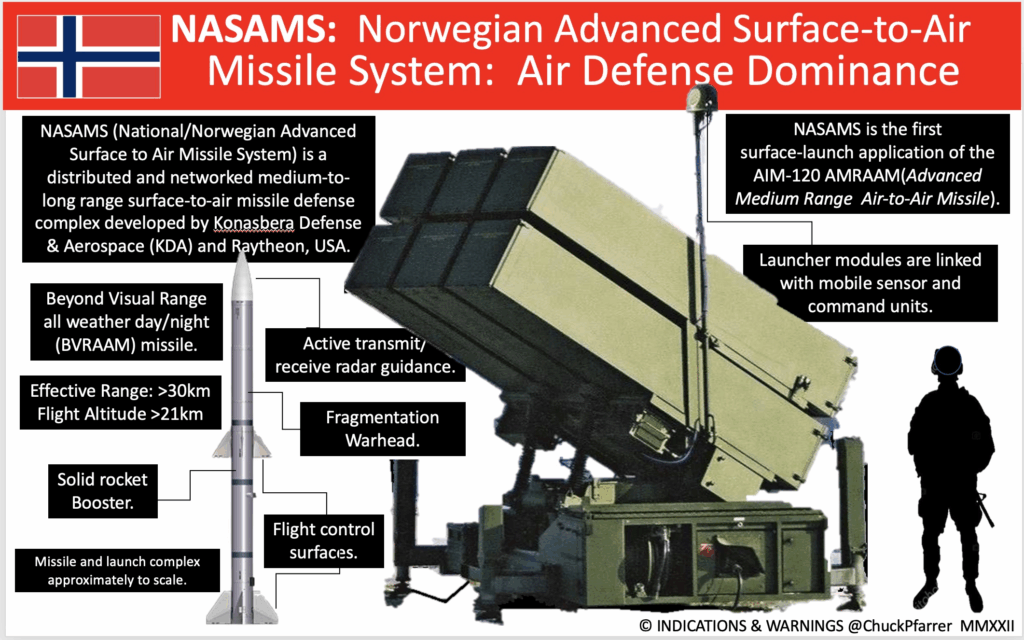
The system integrates U.S.-built radars and AMRAAM missiles with a Norwegian developed battle management system called FDC, short for Fire Distribution Center.
A complete NASAMS 2 battery consists of up to four firing units. Each firing unit includes 3 missile launchers (LCHR), each carrying six AIM-120 AMRAAM missiles, one AN/MPQ-64F1 Improved Sentinel radar, one Fire Distribution Center vehicle, and one electro-optical camera vehicle (MSP500).
Kongsberg stated that NASAMS was in operational use in Norway, Spain, the United States, the Netherlands, Finland, Oman, Lithuania, Indonesia, Australia, Qatar, Hungary, and Ukraine. Poland, Greece, and Turkey operate the Kongsberg Command and Control solution for various weapon systems.
NASAMS has been used extensively in Ukraine and has proven effective and reliable.
.
.
.
.
The Missile Defense Agency has explored some other missile defense concepts and systems—and is likely to develop new systems in the future—but none of those other systems are deployed now or are likely to be deployed soon. MDA also invests heavily in command-and-control systems and sensors to support the missile defense mission.
Past and Planned Use.
During Operation Desert Storm in 1991, the Army used Patriot missiles to defend against Iraqi Scud missile attacks targeted at Saudi Arabia, Israel, and U.S. and coalition forces. The Army’s missiles were early-model Patriots rather than the current PAC-3 design, and their effectiveness in actually shooting down Iraqi missiles has been the subject of debate. (Part of the difficulty in assessing their performance is that many engagements with Scud missiles ended up being near misses that may not have destroyed those missiles, resulting in an ambiguous operational record.) PAC-3 missiles were employed in 2003 during the invasion of Iraq with some success. Currently, PAC-3 missiles are being used to great effect in both Israel and Ukraine. The Israeli use is particularly notable as the Patriot system has been integrated into the Iron Dome missile defense system.
Currently, two of the primary missions for U.S. missile defense systems are to protect the United States against a limited attack by North Korean nuclear-armed ICBMs (using the GMD system) and to protect U.S. forces and allies in Europe against an attack by Iranian nuclear-armed intermediate-range ballistic missiles (using ship-and land-based versions of the Aegis BMD system). Both of those missions involve countering a threat that has yet to emerge, because neither of those countries is currently believed to have effectively combined nuclear warheads and ballistic missiles, and neither has yet fielded missiles with sufficient range.
It is also unclear whether missile defenses are required to counter those threats. U.S. nuclear forces may be sufficient to deter attacks, as they were during the Cold War, although it is possible that a reliable missile defense system could enhance the effectiveness of the existing U.S. nuclear deterrent.
The main intended mission for the THAAD, PAC-3 and NASAMS systems is to defend deployed U.S. forces or U.S. allies against attacks by intermediate-, medium-, or short-range ballistic missiles. Such a mission is not speculative: Short-range ballistic missiles have proliferated widely and were used against U.S. forces in Operations Desert Storm and Iraqi Freedom and are currently in use against targets in Israel, Ukraine and the Red and Arabian seas.