The American Revolution Part 11
With the British Army firmly in control of New York, the decision was made to prosecute the war in the southern colonies due to the large Loyalist population. The war in the northern colonies had slowed to the point that it became known as “The Doldrums”. This did not mean that the war did not continue in the north, it only meant that there were fewer and smaller battles and raids. 1779 would reflect this change of strategy by the British although the war would certainly continue in both the northern and southern colonies.
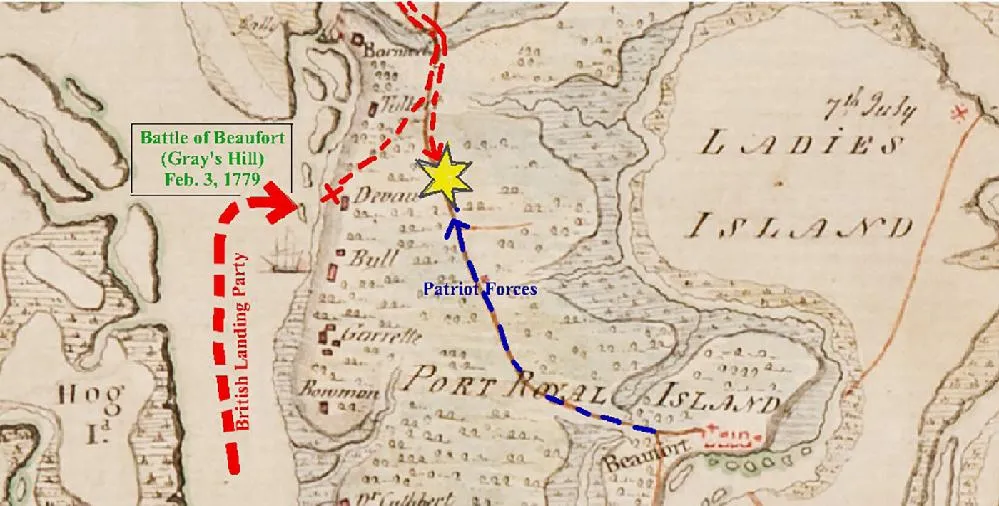
With the capture of Savannah, Georgia, the British began to expand its war efforts by attacking Port Royal Island near Beaufort, South Carolina February 3, 1779. As the British moved against Fort Lyttelton, located on Port Royal Island, Captain John DeTreville spiked the fort’s cannon and blew up the main bastion in order to deny the British use of the fort. In what became to be known as “The Battle of Beaufort”, Major William Gardner’s troops landed on the island. As the British advanced, they were met by Brigadier General William Moultrie’s patriot force on Grey’s Hill, the highest point of land on the island. In what would later be considered an inconclusive action, the British withdrew after taking heavy casualties. The 45 minute battle was a boost for the American’s mainly militia force against Major Gardner’s British regulars.
“The Battle of Kettle Creek” occurred on February 14, 1779 near present day Washington, Georgia. In what was a decisive battle, South Carolina militia under the command of Colonel Andrew Picken’s and a contingent of Georgia militia under the command of Colonel John Dooly joined forces to badly maul British forces under the command of Lieutenant Colonel John Boyd. As a result of this action, British control of the back country of Georgia was not to be until after the British siege of Charleston in 1780.
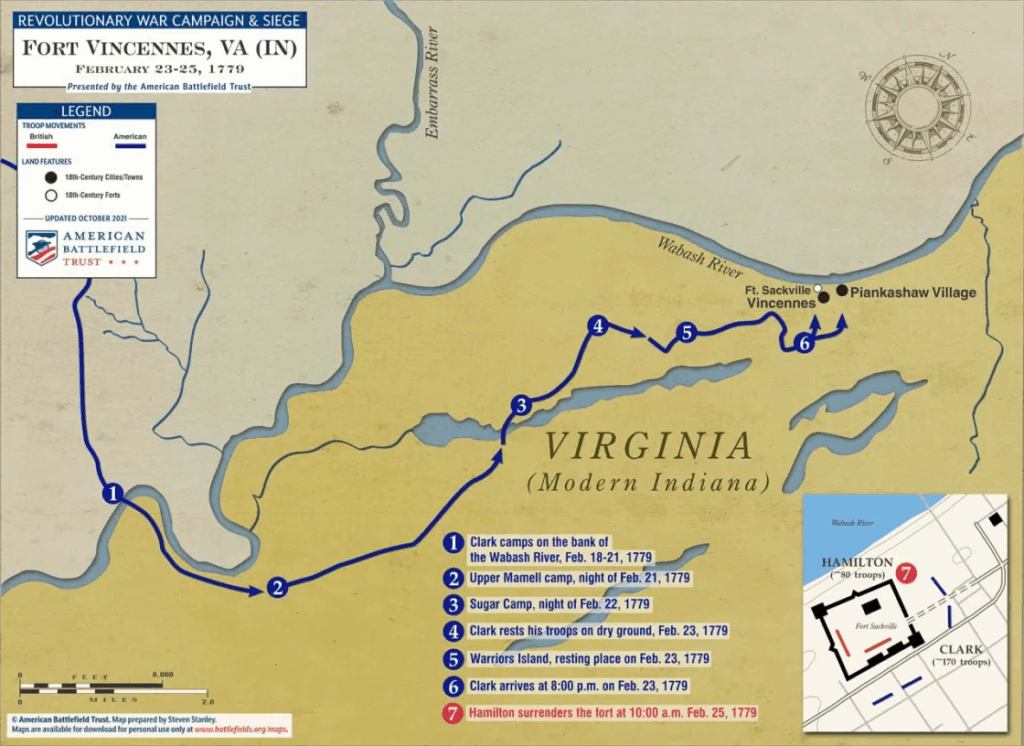
After a grueling 18 day march through a flooded landscape, Lieutenant Colonel George Rogers Clarke with a patriot force of 170 men captured Fort Sackville in a three day siege, February 23-25, 1779, without the loss of a single man in what would be called “The Siege of Vincennes” near the present day city of Vincennes, Indiana. It was hoped that the capture of Vincennes would stop or at least quell the British use of Indian allies against the American settlers west of the Appalachian Mountains.
In a setback to American morale, the British defeated an American force at “The Battle of Brier Creek”’ March 3, 1779 in eastern Georgia. The American force consisted of militia from Georgia and South Carolina plus a small number of Continental troops. British casualties were very light, but the Americans suffered 150 killed and 227 captured plus an unknown number drowned in the swamps as they tried to retreat.
In what was originally considered a defeat, Colonel John Bowman of the Kentucky County militia accompanied by Benjamin Logan attacked the Shawnee town of Old Chillicothe May 29, 1779. They burned the Shawnee town and killed the Indian leader Blackfish. Later considered a victory, this action would discourage further Indian raids against settlers in Kentucky.
In a series of rapid raids between May 10 and May 24, 1779, the British Navy under the command of Commodore Sir George Collier and land forces under the command of Major General Edward Matthew, destroyed various caches of military supplies destroy ships, and economic caches of coal and tobacco in what would be called “The Chesapeake Raid”.
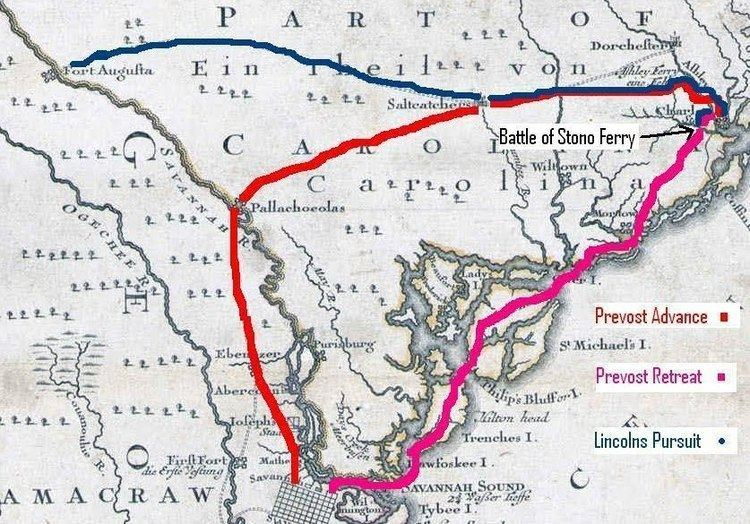
A poorly trained militia force under the command of General Benjamin Lincoln attacked a British force that was retiring from an aborted effort to capture Charleston June 29, 1779. “The Battle of Stono Ferry” began well for the Americans, but two companies of Highlanders resisted until it had but 11 men left; the British raised a counter attack using a contingent of Hessian troops forcing Lincoln to order a withdrawal. American losses were 34 killed, 113 wounded and 115 missing; British losses were 26 killed, 93 wounded and 1 missing. Future President Andrew Jackson’s elder brother Hugh Jackson was among the American Dead.
In an effort to draw General George Washington into a decisive battle, British commander Lieutenant General Sir Henry Clinton ordered Major General William Tryon to conduct a series of raids against the Connecticut ports of New Haven, Fairfield and Norwalk. The raids were conducted from July 5 -14, 1779, but were considered to be ineffectual as they were not successful in getting General Washington to confront General Tryon as General Clinton had hoped.
As part of the joining of American and French forces, the French attacked and captured the Island of Grenada July 2- 4, 1779. In a naval battle July 6, 1779 the French badly mauled a British naval group reinforcing the French attack, allowing the French to retain the Island of Grenada until after the war.
Walt Mow 2025