The American Revolution Part 16
Colonel William Graham built a large log cabin on Buffalo Creek in North Carolina. In a one sided affair, a group of about 20 Loyalists surrounded the cabin on September 1, 1780 demanding that Graham and his 2 companions surrender. After an exchange of gunfire that resulted in 1 dead and 4 loyalists wounded the group left only to return when Graham had left the cabin to loot and destroy some of Graham’s personal property in the cabin.
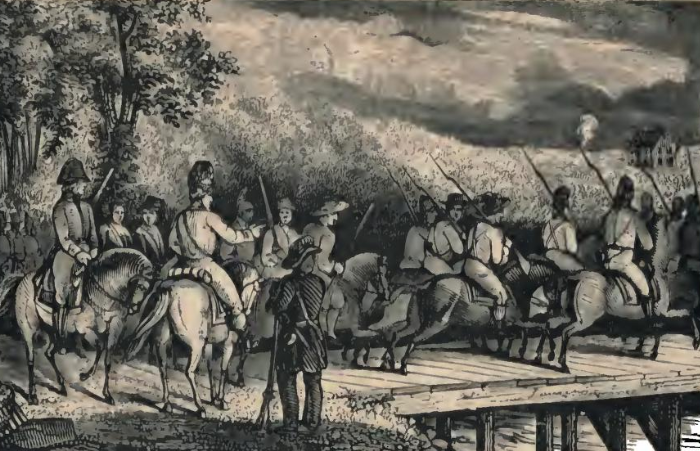
“The Battle of Black Mingo” (September 28 or 29, 1780) saw the Loyalist troops of Colonel John Ball scattered after they blundered into a trap set up by Militia General Francis Marion. Marion set his trap by forming his troops in a semicircular fashion, luring Ball’s troop into an attack against what was a smaller group of patriots. General Marion drove Ball’s troop into the swamps, widely scattering them in the confusion that resulted from Marion’s carefully set trap. Francis Marion was becoming a legend in the southern colonies.

(There is some confusion about the actual date of this encounter, some as early as August and some later in September. I used the more generally quoted date, unfortunately, I cannot be more exact.)
In a bold move, Major William Davie in a surprise attack, September 21, 1780, routed a contingent of the hated Banastre Tarleton’s British Legion and some British light infantry killing 15 and wounding 40 more. The engagement was a total surprise allowing Davie to capture 96 horses and 120 muskets before the much larger portion of General Cornwallis’s army that was camped nearby could respond to Davies’s surprise move. Major Davies’s small group suffered but 1 wounded, but the attack enhanced the Major’s standing as a guerrilla fighter of some note.
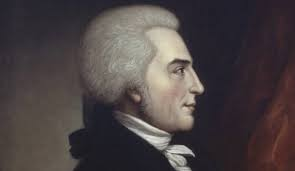


The Mecklenburg County Court House in Charlotte, North Carolina was the site of a battle between Major William Davies’s small Patriot force and the much larger army of General Charles Cornwallis on September 21, 1780. Davies force of 150 men was to offer token resistance but suffered as many as 30 killed and or wounded, while the larger British force suffered as many as 59 killed, wounded or missing.
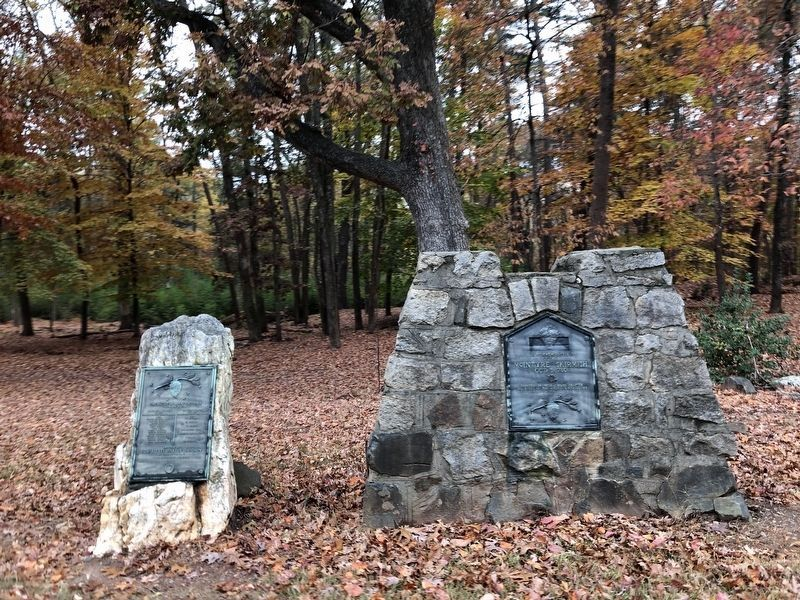
Lieutenant General Charles Cornwallis dispatched a large foraging party consisting of 450 men plus some 60 cavalry to the vicinity of McIntyre Farm as his Army rested at Charlotte, North Carolina. The British force was loading the pilfered booty when they accidentally knocked over several bee hives causing a real commotion. As the bees attacked the men loading the foraged goods, a small group of Patriots under the command of Captain James Thompson attacked the British. The British, thinking they were under attack by a larger Patriot force retreated back to General Cornwallis’s Army leaving behind 10 wagons of the foraged supplies. The small Patriot force reported no casualties while the British suffered 8 killed and 12 in what was called “The Battle of McIntyre Farm”, October 3, 1780.
In what would be called the largest All-American fight of the Revolution, a force of approximately 900 American militia would defeat 1,150 Loyalist militia at “The Battle of King’s Mountain”, October 7, 1780. British Major Patrick Ferguson began recruiting Loyalist militia to challenge the American militia in the mountains of South Carolina. Ferguson challenged the Patriots to lay down their arms or face the consequences, but the Americans rallied and drove Ferguson back towards General Cornwallis’s much larger army catching up with Ferguson’s group at King’s Mountain in rural west North Carolina.
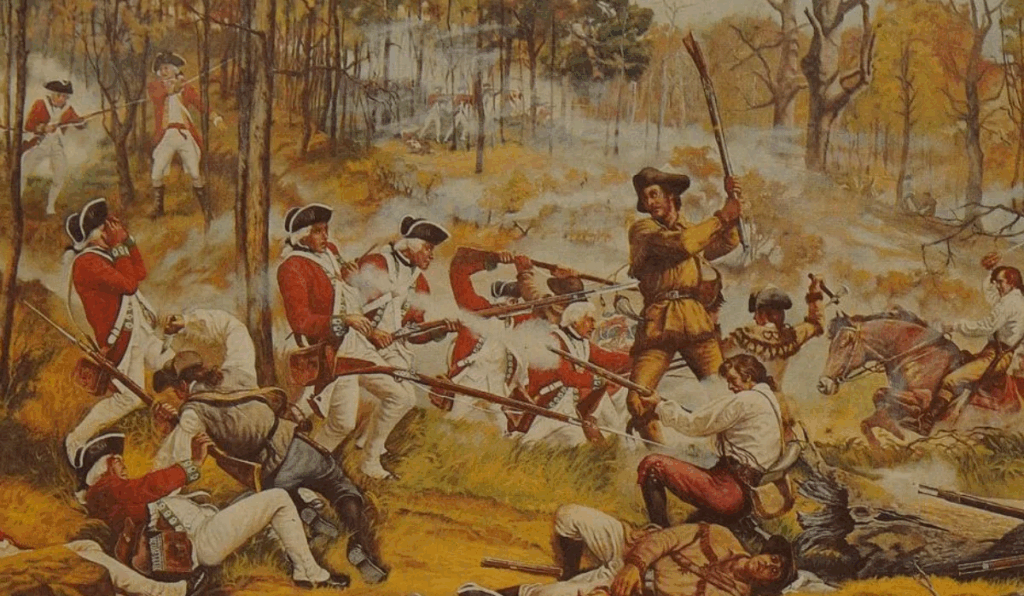
Achieving complete surprise, the Americans surrounded the Loyalist force, killing Ferguson in an hour of fighting as he tried to break the Patriot line. The American militia gave no quarter as they sought revenge for “Tarleton’s Quarter” at the Battle of Waxhaws, killing 290. wounding 163 and capturing 668 while suffering 28 killed and 62 wounded. Patriot morale was greatly enhanced by the defeat of Ferguson’s militia, forcing Cornwallis to leave South Carolina and eventually retreat into Virginia.
Another Patriot victory was achieved on October 14, 1780 at “The Battle of Shallow Ford” as 300 Patriots laid an ambush about a mile from the ford under the command of Major Joseph Cloyd. The Loyalists, numbering about 350, were spread along a ridge when the Patriots opened fire killing 14 and scattering the rest while the patriots suffered 1 killed.
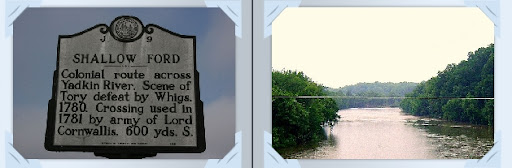
This small engagement, like others, kept reinforcements from reaching General Cornwallis forcing him to retreat into North Carolina, reinforcing the fact that the back country of both North and South Carolina could not be held by British Forces.
The guerrilla tactics employed by Marion, Sumter, Davie and others created a nightmare for the British. The European style of fighting did not comport well with the unorthodox fighting style of the small hit and run raids that the Americans executed so well. That the British found them to be exasperating for the kind of major battles they wanted in order to win is just as well for WE THE PEOPLE may have never been able to enjoy the kind of government that our forefathers created.
Walt 2025