The American Revolution Part 17
The last major Indian raid on settlers in New England occurred October 16, 1780 when 300 Mohawk Indians led by Lieutenant Richard Houghton attacked and burned the Vermont towns of Royalton, Sharon and Tunbridge killing 4 settlers and taking 26 prisoners known as “The Royalton Raid”.

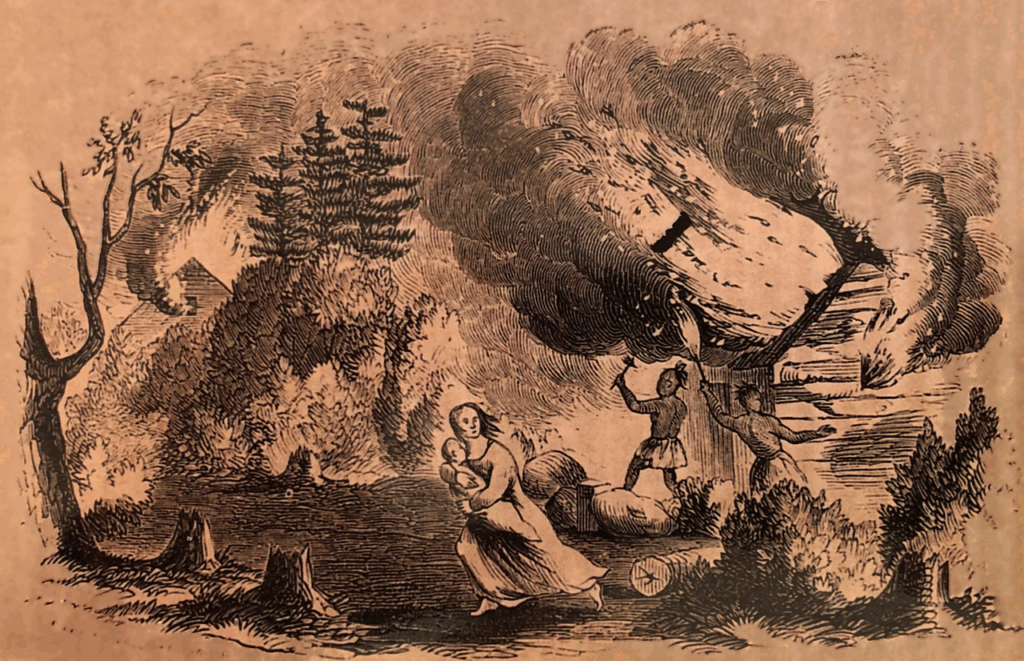
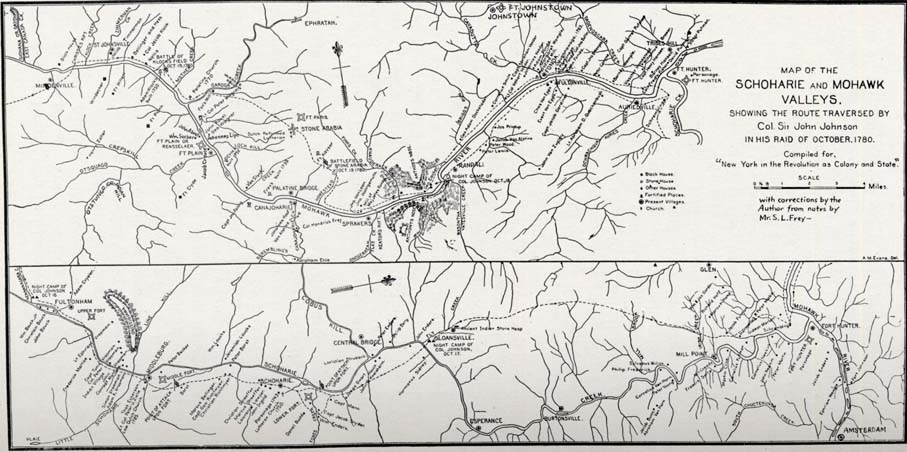
In what later was considered an inconclusive series of actions, raids were carried out in conjunction with military actions along the shores of Lakes Champlain and George by Major Christopher Carleton as another raid was conducted by Lieutenant Colonel Sir John Johnson in the Mohawk Valley of New York. From October 16 through October 20, 1780, British forces and their Indian allies burned homes and crops across the Mohawk Valley of New York. “The Battles of Klock’s Field” and “Stone Arabia” were fought with neither side being able to claim a victory.
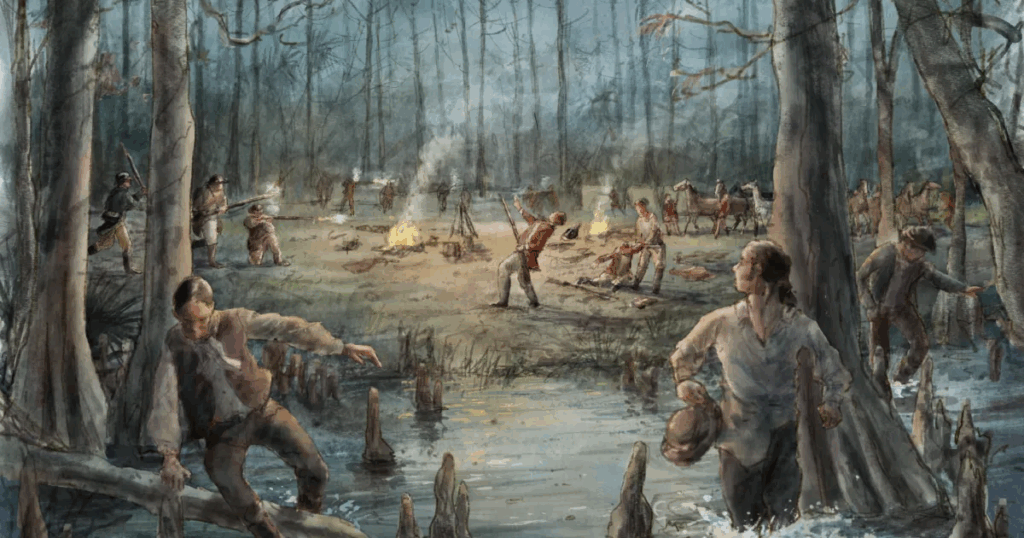
“The Battle of Tearcoat Swamp” was a decisive battle for then Lieutenant Colonel, soon to be Brigadier General Francis Marion. He led 152 men against Lieutenant Colonel Samuel Tynes 200+ loyalist recruits in a midnight attack when the newly recruited loyalists were at their most vulnerable. Arranging his men in a U-shaped formation with Marion himself in the center, he discharged his pistol signaling the attack to begin, the wings charged the unsuspecting recruits on horseback shooting and yelling. Marion’s small force killed 6, wounded 14 and captured 26 while sustaining two horses lost, capturing 80 muskets plus a number of horses and foodstuffs. Many of the loyalist recruits escaped into the swamp before they could be captured. Marion’s fame continued to grow while Loyalist sentiment in Clarendon County South Carolina was severely quelled.
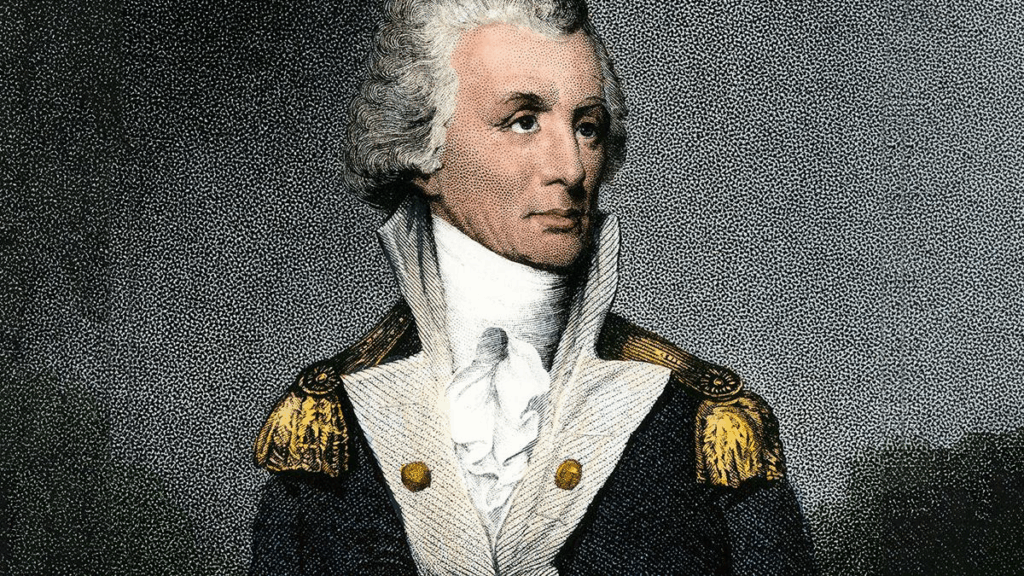
01:00, November 9, 1780, British forces under the command of Major James Wemyss attempted a surprise attack against militia forces under the Command of Brigadier General Thomas Sumter. Sumter ordered his men to sleep with their arms close at hand and keep their fires burning so as Wemyss’ troops attacked, they were lit for Sumter’s forces to easily see the attackers. Major Wemyss was wounded in the opening volley by Sumter’s troops who were lined up in the woods. As the British attackers charged into Sumter’s camp, they became entangled in a fence they did not see in the darkness making them vulnerable to Sumter’s riflemen. As the British retreated from the field they left behind Major Wemyss and 20 others wounded or killed. Again, Sumter’s unorthodox tactics not only defeated British forces but enhanced Sumter’s growing fame in the southern colonies.
Lieutenant General Charles Cornwallis ordered Lieutenant Colonel Banaster Tarleton to abandon his efforts to catch Brigadier General Francis Marion and disrupt the militia under the command of General Sumter. On November 18 Tarleton’s troopers were fired on by some of Sumter’s men as the British were watering their horses. Rousing his troops, Tarleton crossed the river, pushing the American militia back; they caught up to Sumter’s main force late the following afternoon. Sumter and his officers decided to make a hard stand at a place called “Blackstock’s Farm”, November 20, 1780.
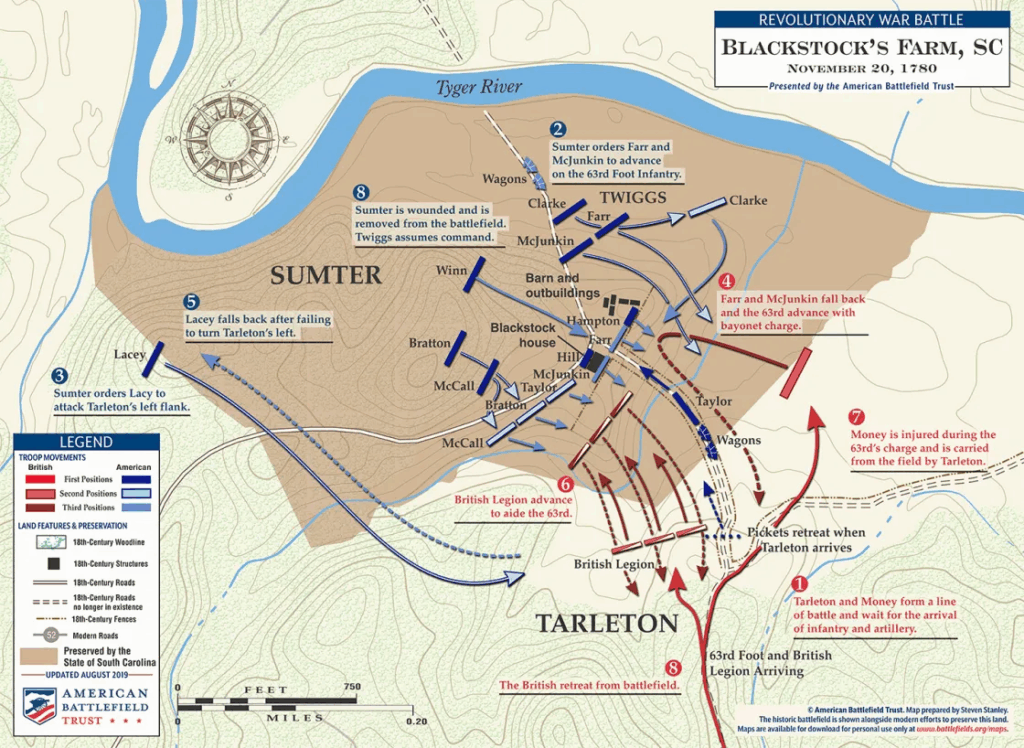
An impetuous Tarleton ordered a charge against the waiting American militia and put Major John Money to charge the waiting militia with bayonets. Major Money was killed in the attempt while American militia firing from a grove of trees disrupted the waiting dragoons. In another brave attempt, Tarleton and his troopers charged uphill trying to dislodge the militia, losing a number of troops and horses in the attempt. A severely wounded Thomas Sumter had to be removed from the battle, turning command over to his senior colonel John Twiggs. British casualties were 51 killed or wounded while the Americans suffered 3 killed,4 wounded and 50 captured. As a result of Sumter’s wounds. General Washington sent Major General Nathaniel Greene to replace Brigadier General Thomas Sumter.
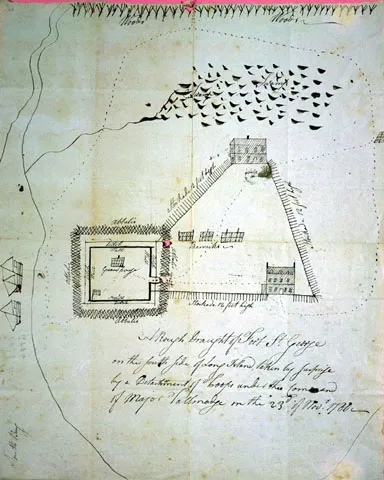
In a daring predawn raid, Major Benjamin Tallmadge led his small force in an attack with unloaded weapons, utilizing bayonets only. Not only was Major Tallmadge’s raid against loyalist held “Fort St. George” successful on that early morning of November 23, 1780, his troops captured 54 and killed 7 while the Americans suffered 1 wounded in a fight that lasted about 10 minutes while destroying Loyalist military supplies. The forerunner of the Purple Heart was awarded Sergeant Elijah Churchill, “The Badge of Military Merit”.
The last major action of 1780 occurred on December 30, 1780, when Lieutenant Colonel William Washington’s cavalry troop caught up with a group of loyalist raiders commanded by Lieutenant Colonel Thomas Waters. Water’s troopers had stopped to have a midday lunch but were attacked by Washington’s troopers. A small contingent of militia under Washington’s command opened fire on the flanks of the loyalists as Washington’s dragoon sliced through the loyalists, scattering them. Not a single American was injured in the “Battle of Hammond’s Store”, while the loyalists suffered 100 killed,40 wounded and 50 captured.
Walt Mow 2025