The American Revolution…Part 19
The “Battle of Wetzell’s Mill, March 6, 1781 pitted 600-700 hundred militia commanded by Colonel Otho Williams against approximate 1,200 Loyalists and militia commanded by Lieutenant Colonel Banastre Tarleton as Major General Nathaniel Greene tried to avoid a major battle with General Charles Cornwallis by crossing the Dan River. General Greene sent Colonel Williams to confront Banastre’s Loyalist troops; Williams dispatched “Harry Light Horse’ Lee to slow Banastre’s advance, Lee crossed the ford and Williams deployed his troop to confront Banastre’s Loyalist militia. Williams’ group had 10 killed and 20 wounded while the British forces had 30 killed and wounded. This action allowed General Green the time he wanted as he received additional troops and supplies while Cornwallis was held back due to heavy flooding on the Dan River.
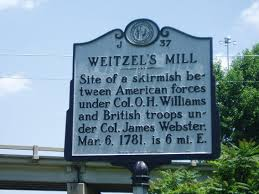
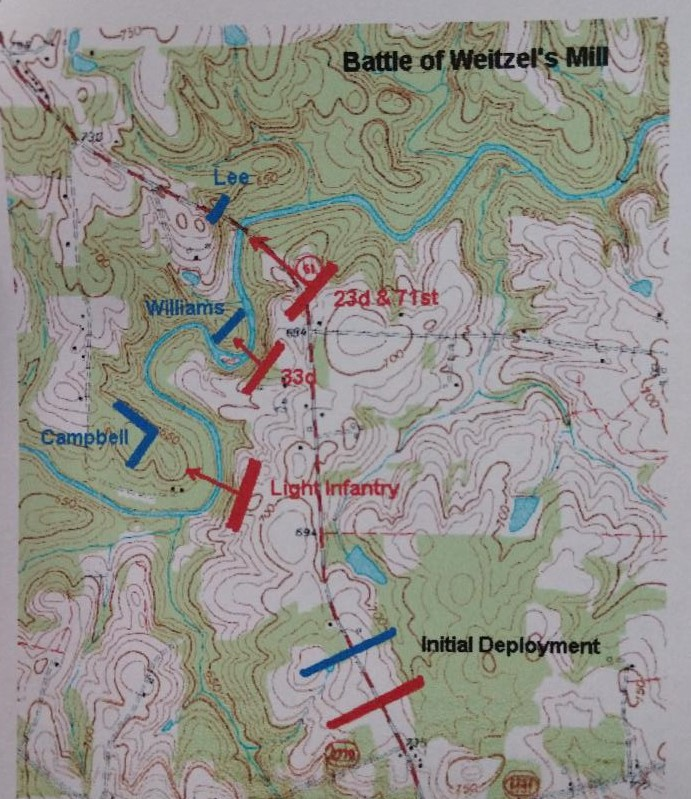
*Editors note: The spelling of the location here is somewhat flexible. It is written as Wetzell, Weitzel, Whitsell, Whitesell or Whitsall depending on the source. The consternation this caused was considerable, this editor strives to provide the most accurate images for this series. Rest assured, they are all the same place and describe the same battle. Consistent spelling as we know it today wasn’t really a thing prior to the mid-to-late 19th century.
In what has been called the biggest, most consequential and hotly contested Revolutionary War battle in the southern colonies, Lieutenant General Charles Cornwallis defeated Major General Nathaniel Greene’s army at “The Battle of Guilford Courthouse”, March 15, 1781. Greene’s losses were 79 killed and 185 wounded with a large number of the militia returning home after the battle. Cornwallis lost about 27% of his fighting force with 93 killed, 413 wounded and 26 missing. Cornwallis in his haste to confront Greene’s army had pushed his troopers to the point of exhaustion in an effort to force a battle with Greene’s men. As Greene turned his army back into South Carolina, Cornwallis was forced to plunder the residents of the area to feed and supply his weary troops. He then marched to Wilmington, North Carolina to rest and resupply his troops.
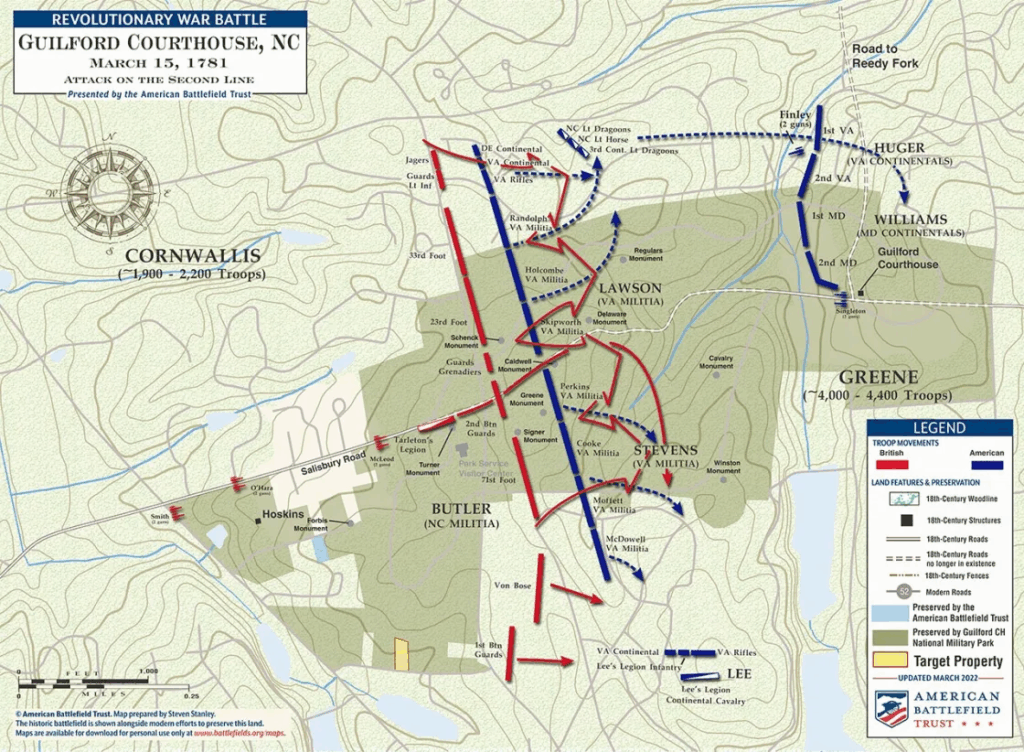
After reviewing the battle reports of the Pyrrhic fight, British Whig Party leader and war critic, Charles Fox declared that, “Another such “Victory” would ruin the British Army.”
An inconclusive naval battle occurred on the same day as the Battle of Guilford Courthouse between British ships of the line and French vessels at “the Battle of Cape Henry”. Both contestants suffered casualties with the British sustaining 30 killed and 73 wounded while French casualties numbered 72 killed and 112 wounded. As neither side could claim a victory, the French returned to Rhode Island while the British took up station off the coast of Chesapeake Bay.
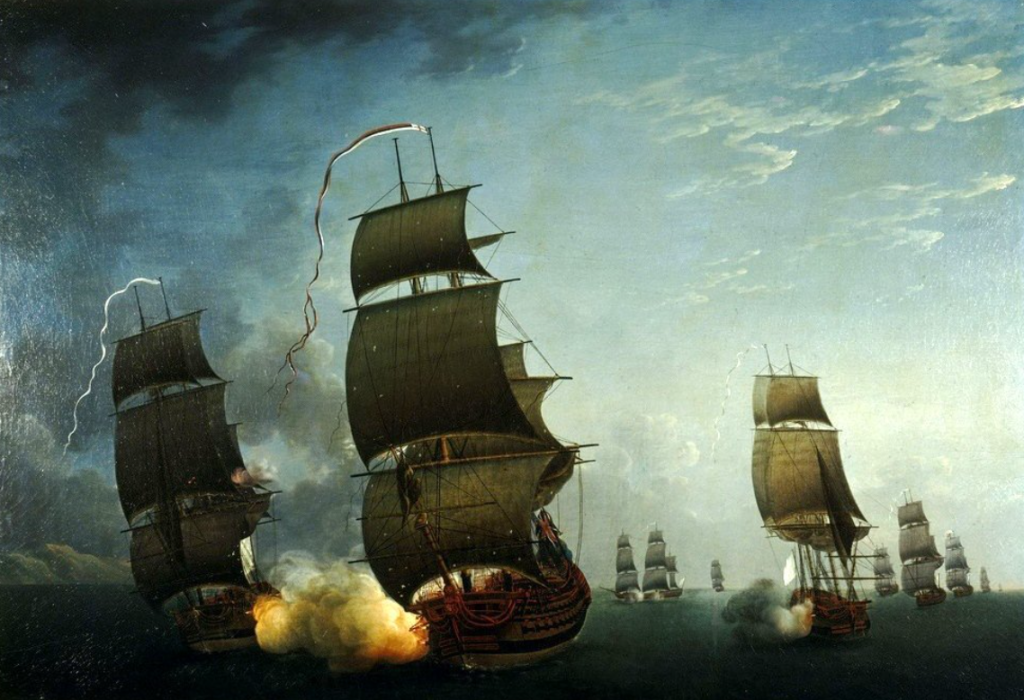
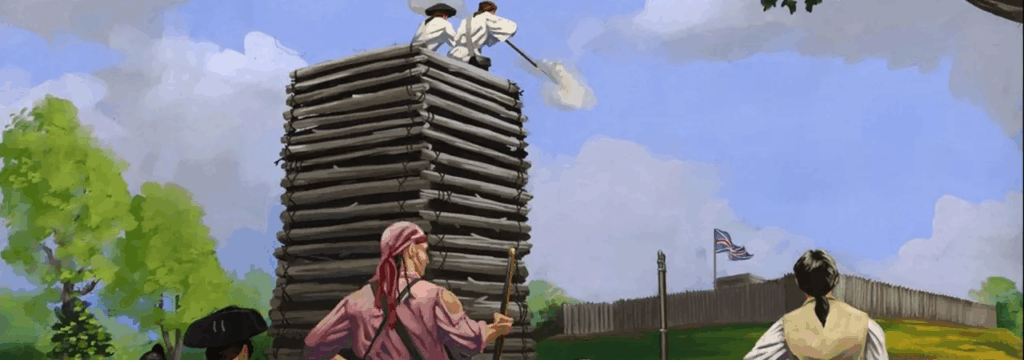
In a rather bizarre encounter, Light Horse Harry Lee and Francis Marion besieged an outpost that guarded communications and supply lines between Charleston and Camden South Carolina. “The Siege of Fort Watson” started April 15, concluding April 23, 1781 after the men constructed a 30 ft high tower that allowed sharpshooters to fire into the fort. Lieutenant James McKay surrendered the fort to the joint forces of Lee and Marion.
April 25, 1781 was to witness two separate actions that were both British victories. “The Battle of Blandford” pitted approximately 1,000 militia under the command of Major General von Steuben against some 2,300 British regulars commanded by Brigadier William Phillips. General von Steuben was joined in the battle by General Peter Muhlenberg; the two men directed a strong defensive effort by retreating across the Appomattox River, avoiding a flanking measure by British forces. General Phillips was assisted by none other than the traitor, Brigadier General Benedict Arnold. The poorly trained militia of von Steuben and Muhlenberg retreated to Richmond where they joined the Continental forces commanded by the Marquis de Lafayette.
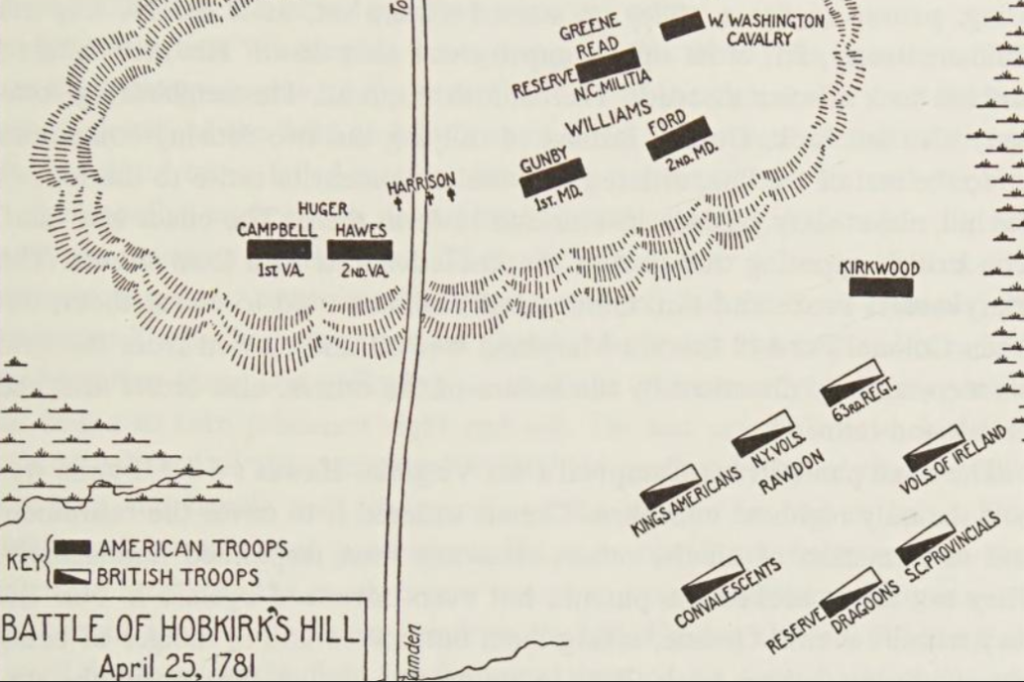
The second battle on April 25, 1781 occurred near Camden, South Carolina where General Nathaniel Greene with a force of about 1,550 confronted the much smaller force commanded by General Francis Rawdon. Rawdon’s force of 900 forced a retreat by Greene’s militia. This engagement would be called “The Battle of Hobkirk’s Hill”. Despite Rawdon’s victory, he retreated to Camden, only to eventually retreat towards Charleston, South Carolina.
As General Rawdon retreated from Hobkirk’s Hill, he retreated towards Fort Motte, a mansion at the confluence of the Congaree and Wateree Rivers. “Swamp Fox” General Francis Marion and Lieutenant Henry “Light Horse Harry” Lee intended to capture the fort before Rawdon’s arrival. Accordingly, they put the fort under siege May 8, 1781 but were unable to force Lieutenant Daniel McPherson to surrender the fort. On May 12, they set the mansion on fire using fire arrows plus Marion’s artillery fired on the mansion finally forcing the British to surrender the fort to American forces.
May 16, 1781, a Patriot scouting party discovered a group of Loyalist troopers at Portevent’s Mill near present day Garland, North Carolina. The Patriots under the command of Colonel James Kenan formed up his men and attacked the Loyalist group under the command of Captain Middleton Mobley. In an intense fight, the patriots were able to drive the loyalists into nearby Black Swamp after killing 12, wounding 4 and capturing 12. Kenan’s casualties would be 3 killed and 3 wounded in this small engagement at “The Battle of Portevent’s Mill”.
Walt Mow 2025