America at 250: Our Lost Opportunity
Robert Pondiscio for Commentary May 2026
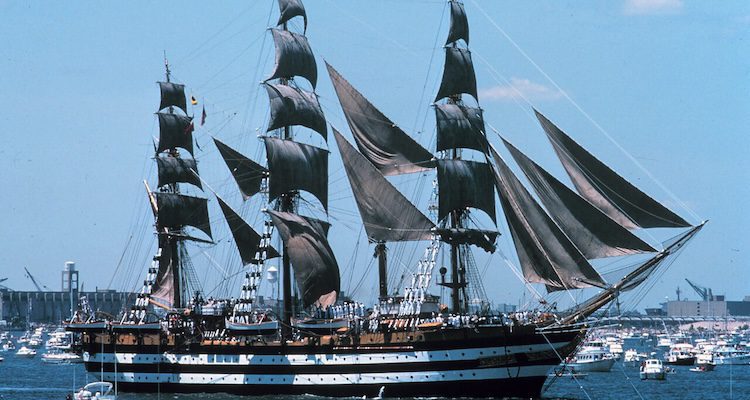
A few days after school let out in early July 1976, I mounted my bike on a warm, cloudless morning and headed for water. I didn’t ask permission. I didn’t tell my parents or anyone else where I was going. I just pedaled to Huntington Harbor, miles from my boyhood home on Long Island. I was in search of “tall ships,” at least a dozen of them, which had sailed into Long Island Sound and anchored in the waters where I’d often fished for flounders and eels with my dad.
For weeks leading up to the Fourth of July, much of the country had been transfixed by the ships’ journey. Historic sailing vessels from around the world were converging on New York Harbor, the largest such gathering in modern history, drawing a vast spectator fleet and becoming the signature spectacle of the American Bicentennial. I was 13 years old, a boy awed by the sight and dimly aware that I was witnessing something important. The nation was turning 200, and history itself had come to town.
Fifty years on, American childhood has changed and so has America. We are more anxious and fragmented, less confident, and quite incapable of sharing a moment of uncomplicated civic pride. The Bicentennial arrived in a country that could still celebrate itself. The Semiquincentennial will not, at least not universally. It can’t.
With the benefit of hindsight, I see how powerfully 1976 shaped me. The Bicentennial kindled an attachment to the country that I took for granted and didn’t recognize at the time, but that quietly ordered much of what came after. I have spent my adult life in two professions, journalism and education, which are (or at least ought to be) rooted in the assumption that our founding principles are worth examining, transmitting, and defending. Such a belief does not arise spontaneously. It must be cultivated. The nation still knew how to do that 50 years ago. As America approaches its 250th anniversary, faith in those shared ideals feels rare, even endangered.
The Bicentennial hit with implausibly perfect timing. I was old enough to pay attention, young enough to be captivated, and impressionable enough to be formed by what my country chose to emphasize about itself. For two full years leading up to the big day, CBS aired a nightly “Bicentennial Minute”—a brief history lesson on something that had happened exactly two centuries earlier: a battle or a speech in the Continental Congress, sometimes a moment so small that I didn’t yet grasp its significance. I wouldn’t tune in for the “Bicentennial Minute” so much as stumble upon it, the way everyone else did, as it surfaced amid our nightly diet of sitcoms and the evening news. The details mattered less than the rhythm: night after night, a quiet reminder that the country had a collective past, a shared story we held in common.
At the same time, I was in eighth grade, the year we studied American history. The convergence was almost magical. What I learned in school during the day was reinforced at night on television and echoed in daily life and popular culture. Bored one afternoon, with the TV inevitably on in the living room, I stumbled on the movie version of the musical 1776 and was instantly smitten. The Founding Fathers were no longer steel engravings or oil-paint portraits in my middle school social studies textbooks. They bickered and told bawdy jokes, doubted themselves, argued fiercely, and sang and danced while doing so. It was Hamilton before Hamilton (even Lin-Manuel Miranda agrees to this). I borrowed the original cast album from the library and wore it out on the stereo in my bedroom. The American Revolution began to feel like a human drama whose outcome depended on fallible people making momentous choices.
All of this was deeply formative. The Bicentennial didn’t just teach me America’s history, it cemented me to it. Without fully realizing it, I was becoming a citizen, and an invested one.
No less than today, America then should have been in no mood for celebration. The mid-1970s were marked by Vietnam, Watergate, inflation, domestic unrest, a drug-abuse crisis, economic shocks, and a general sense of national drift. Confidence in institutions was shaken. Then as now, trust in leadership—two years after the resignation of a president awash in scandal—was thin. Yet the country still found it in itself to celebrate.
The tall ships were only the most visible sign. Towns and cities staged parades and pageants. Families traveled to historic sites. You held on to the Bicentennial quarter in your pocket; it felt treasonous to spend it. Even the excess—the trinkets, the commemorative plates, the awkward colonial costumes—felt earnest rather than cynical. The celebration was not triumphalist, but it was affirmative. It assumed that the American story was worth knowing, worth passing on, worth celebrating despite everything that had gone wrong and continued to.
To be sure, the Bicentennial was also relentlessly commercial—and not always in flattering ways. Much of it was kitschy, crass, and transparently designed to separate Americans from their money. 7UP issued 50 state-themed soda cans designed to be collected and stacked to create a portrait of Uncle Sam. Fast-food chains sold commemorative glassware. Airlines painted their planes red, white, and blue. Commemorative coins, stamps, mugs, plates, and souvenirs flooded American homes. The commercialization didn’t ennoble the moment—but it didn’t poison it, either.
All of this pageantry was possible because no one mistook a soda can for a political act. No one seemed to worry that a patriotic display might be construed as a vote of confidence in the president or his party. Our contemporary instinct to plumb every event or gesture for partisan advantage—or liability—had not yet hardened into habit. The Bicentennial benefited from a national culture still capable of keeping separate opinions about the nation’s political leadership and the country at large—a capacity whose disappearance goes a long way to explain why the coming Semiquincentennial feels less like an occasion than a missed opportunity.
Of course, my memories of 1976 are filtered through the soft focus of adolescence. My Bicentennial was that of a child—bright colors, parades, fireworks, and grown-ups who seemed, at least to me, united in celebration. I have no doubt that adults were having serious debates about the meaning of the Founding and the nation’s unfinished business, even if I have no personal recollection of them. It may also be fair to criticize the Bicentennial as sentimental. It simplified history. It foregrounded heroes and ideals while soft-pedaling contradiction and failure. Given today’s sensibilities, that can look reductive, even naive.
And yet even the sentimentality and commercial crassness did something essential.
It attached me to the country without asking or expecting me to judge it. And given the parlous times of my childhood—Vietnam, Watergate, years of radical foment and political violence still fresh in memory—the timing could not have been more fortuitous.
As America approaches its 250th birthday, I feel less anticipation than melancholy. Civic rituals are now parsed as partisan signals. Affection for the country must be hedged, explained, contextualized. Not long ago, Colin Kaepernick successfully pressured Nike to recall a sneaker adorned with the 1776 “Betsy Ross” flag, a bedrock piece of our iconography, claiming that it was associated with slavery and racism. Likewise, the Gadsden “Don’t Tread on Me” flag—once a broadly intelligible expression of a distinctly American temperament, rough-edged, defiant, and allergic to authority—has become so politically coded that it functions less as shared civic inheritance than as an ideological signal. Writing in the industry trade publication Adweek, the CEO of one of the nation’s largest ad agencies framed the coming Semiquincentennial as a “defining crossroads” for marketers and urged them to confront “the full, complicated history of this country, a history that includes freedom and oppression, bravery and brutality, progress and pain.”
The same dynamic that has rendered founding-era symbols politically radioactive and made advertisers more circumspect than they were 50 years ago has also foreclosed the possibility of anything like the “Bicentennial Minute.” Over more than two years, the segments were hosted by an improbably broad cross section of American life. Elected officials from both parties, the first lady and cabinet members, journalists, historians, astronauts, civil rights leaders, and Hollywood celebrities whose fame rested on mass appeal—all took their turn telling Americans, “Two hundred years ago today…,” participating in a civic project that assumed the nation’s past belonged to everyone.
That assumption no longer holds. Today, celebrities either lean ostentatiously into political identities or avoid civic engagement altogether for fear of backlash. The result is not merely the absence of something like the “Bicentennial Minute” but the impossibility of it. A culture in which every public gesture is interrogated for partisan coding cannot sustain a ritual whose sole purpose is to affirm shared inheritance. What once functioned as a nightly civic pause would now be instantly subsumed into political interpretation, social media outrage, and reputational risk management. We have forgotten a crucial distinction: America is no longer meaningfully separated from the politics of the moment. Our feelings about the country and its administration blur together, and many Americans now see nothing to celebrate in a nation that elected a president they cannot stomach. To celebrate feels like a political endorsement; to abstain feels like virtue.
We could not have known it at the time, but we were also living in the last days of the three-network, Time-and-Newsweek world that functioned, for all its flaws and limitations, as a civic commons. When the Bicentennial unfolded, it did so on a shared stage. Even those who were indifferent knew what was happening. It could not be avoided.
The fragmented, partisan media and culture of 2026 offer few comparable moments of collective attention, and those that do break through tend to be disasters—9/11 rather than July 4th. A nation that comes together only in trauma will struggle to cultivate attachment in a moment of joy. The three-network world of 1976 mattered not because it was orderly or enlightened, but because it created a shared stage—one on which the nation could briefly appear to itself as a collective rather than a coalition of warring factions. When the Bicentennial unfolded, it did so before a national audience that, however divided on policy and politics, still recognized certain civic rituals as belonging to everyone.
Today, that shared stage has vanished—and worse, its disappearance has coincided with and arguably midwifed a political culture of perpetual dissatisfaction. Alarm is not a byproduct of politics; it is the fuel. Outrage drives attention. Grievance mobilizes voters. Shared reflection and pride, by contrast, are politically inert. They do not activate donors, juice turnout, or sustain engagement. As a result, we are encouraged—by media incentives, by partisan messaging, by the logic of modern politics itself—to remain in a constant state of agitation. Contentment becomes complacency. Gratitude feels like surrender. We have trained ourselves to ask “Who benefits?” That reflex makes shared celebration nearly impossible.
All of this helps explain why the Semiquincentennial feels so anemic before it has even arrived. The distinction between the nation and the moment has collapsed. Our relationship to America is becoming temporary, transactional. A nation that never rests from politics will eventually find it cannot celebrate itself at all.
It is too late to re-create 1976. The opportunity to stitch children permanently into the fabric of our nation has passed even before the day itself arrives. The Semiquincentennial will come and go largely as another date on the calendar. If a young child disappears for the day on a solo bike ride to look for America, an Amber Alert would not be out of the question.
The differences between our world and the world of the Bicentennial are not trivial. But that does not absolve adults—especially those of us in education, journalism, or cultural and civic institutions—of responsibility. Our obligation is not to duplicate the Bicentennial but to remember what it did well: It attached young people to a country before asking them to judge it; it distinguished the nation from the politics of the moment; it created room for patriotism without blindness, and critique without contempt.
Children are not historians. They are learning what deserves their loyalty and care. You cannot reform what you do not care about. You cannot repair what you have never learned to cherish. You must love something before you endeavor to change it. This is not indoctrination. Indoctrination forecloses critique. Informed patriotism makes examination and critique possible by giving young people a stake in the outcome. A citizen who feels no sense of belonging is not liberated, only detached—and detachment is a poor foundation for democratic self-government.
If we cannot give young Americans a shared national celebration, we can still give them something else: adults who absorb tension so children don’t have to; institutions that teach ideals before indictments; and educators who understand that attachment is the prerequisite, not the antithesis, of an honest reckoning.
I still have a memento of the Bicentennial. It’s a heavy, two-volume, lavishly illustrated and slipcased copy of 200 Years: A Bicentennial Illustrated History of the United States, published by U.S. News & World Report. These days it serves a humbler purpose: stacked beneath my laptop to bring the camera up to eye level for Zoom calls.
But the book itself was clearly meant as a keepsake—something to be owned, handled, saved, and passed on. It reflected the Bicentennial’s unofficial civic tone perfectly: Celebrate the Founding without sanctifying it; acknowledge injustice without defining the nation by it; frame history as inheritance, not indictment. It followed the advice given to President Ford by scholars and intellectuals as he prepared his Bicentennial remarks to the nation—an understanding of America as a continuing experiment, not a completed moral ledger. The book assumed something that now feels almost quaint: that a major national publication could address Americans as a common audience, unified by the shared story of the nation.
July 4, 1976, ended for me, like most days of my childhood, in the glow of a television set. The Boston Pops played “The Stars and Stripes Forever” as fireworks burst over the Charles River. I remember the stirring music, the reflections on the water, the camera pulling back.
At age 13, I didn’t want it to end.
At 63, I still don’t.
Photo: Harley D. Nygren/NOAA’s America’s Coastlines Collection/Wikimedia
For those who may complain about the length of the article, I make NO apology. It is worth the time and thoughts.