Nitrogen Fertilizer… the answer to high crop yields…
The United States has an estimated 322 Trillion Cubic Feet of proven natural gas reserves… the primary feed stock in the manufacture of nitrogen fertilizer. A large portion of this gas is locked in shale, this requires fracking in order to unlock this valuable resource.
At the present time headlines decry the lack of sufficient nitrogen fertilizer available to American farmers. With a plethora of natural gas available, how is it that there are shortages for the American farmer?? Is this a contrived shortage, or are there circumstances that drive this situation?? Just for reference, the Marcellus shale produces a whopping 13 Billion Cubic Feet of Natural Gas daily. With this kind of production, I cannot understand or ascertain what is truly driving this shortage.
There are two types of commercial nitrogen fertilizers, granular urea and ammonium nitrate. Ammonium nitrate (AN) is usually applied as a liquid with a 34% nitrogen content. Commercial urea (CH4N2O)for crop use is rated at 46% nitrogen content. There is no difference between commercial and consumer urea fertilizer. Urea is the most common source of consumer nitrogen fertilizer used in gardens and lawns and is closely tied to the price of natural gas.
Organic nitrogen fertilizers run from animal waste, fish offal and green manure crops. Animal waste is usually bovine and poultry excrement that has been composted as they can burn plants if not composted. Fish offal is also a good source of nitrogen fertilizer for the consumer as it will not burn plants. Green manure crops are plant sources that are plowed under in order to let the natural nitrogen content be leached back into the soil. Until the early 20th century, these were the only sources of nitrogen fertilizers available.
Editor’s note: As is usually the case, as I prepped this piece for publication, I went down the rabbit hole that Walt provided a glimpse of. Here are the headline #s and other major info I found.
- In 2022, the U.S. produced 36.6 million metric tons of nutrient fertilizer, representing 8.4% of the global total.
- Nitrogen, which made up 61% of U.S. production by 2022, consumption is more than double that of phosphate and potash. The U.S. is a major producer but still imports nitrogen to meet demand.
- U.S. phosphate production dropped nearly 36% between 2006 and 2022. Imports make up about 10–12% of supply.
- The U.S. has very low domestic production of potassium chloride, with imports accounting for a massive share of the supply.
- U.S. fertilizer supplies are heavily reliant on imports, particularly for potash (roughly 90%+ dependence) and to a lesser extent, nitrogen and phosphates.
Many of you have seen this map, or one like it purporting to show the % of farmers unable to afford fertilizer this year.
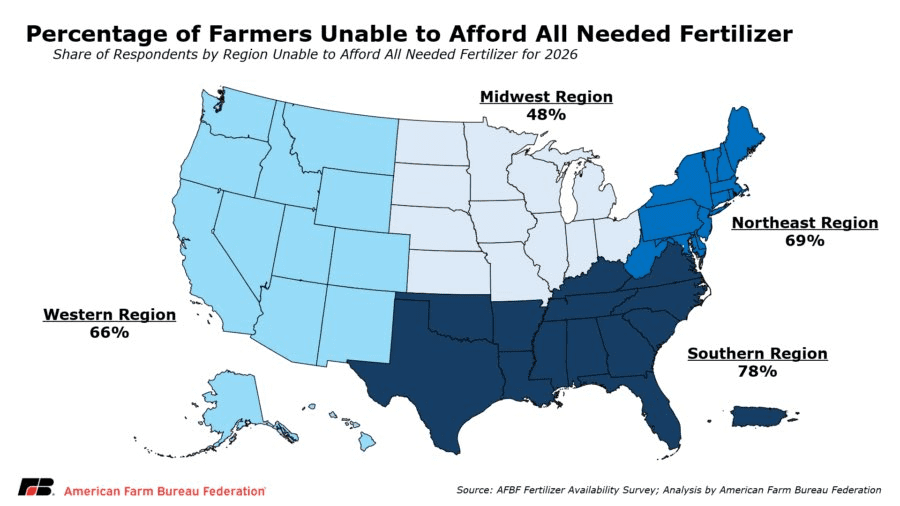
That is only part of the story. Farmers in the Midwest and West ‘pre-booked’ their fertilizer. That locked in a lower price. Additionally, the crops grown in the south, cotton, peanuts and rice require more fertilizer to be profitable than say wheat, corn or soy.
There may be hope though. More than one petrochemical plant is switching from DEF (diesel exhaust fluid-a liquid urea compound used to encapsulate diesel emissions) to pelletized urea for fertilizer. There are also signs that Florida phosphate production is increasing.