The American Revolution… Part 21
“The Battle of Eutaw Springs” on September 8, 1781 marked the end of major land battles in the Carolinas. Clams and counter claims by both commanders as they sought to claim victory when in reality, neither side completely bested the other. The casualty figures by both sides only added to the confusion as to which side was the actual victor. Major General Nathaniel Greene’s casualty report was adjusted to a final count of some 579 killed, wounded, captured and missing. British Colonel Alexander Stewart’s casualty report totaled some 882 killed, wounded, captured and missing. Lieutenant Colonel William Washington was wounded in the battle and taken prisoner for the duration of the war.
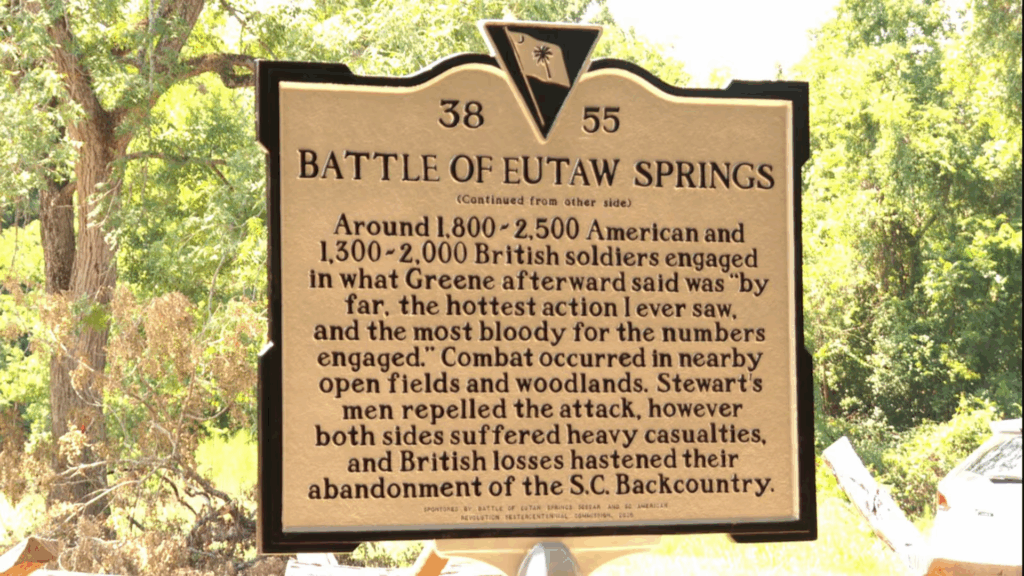
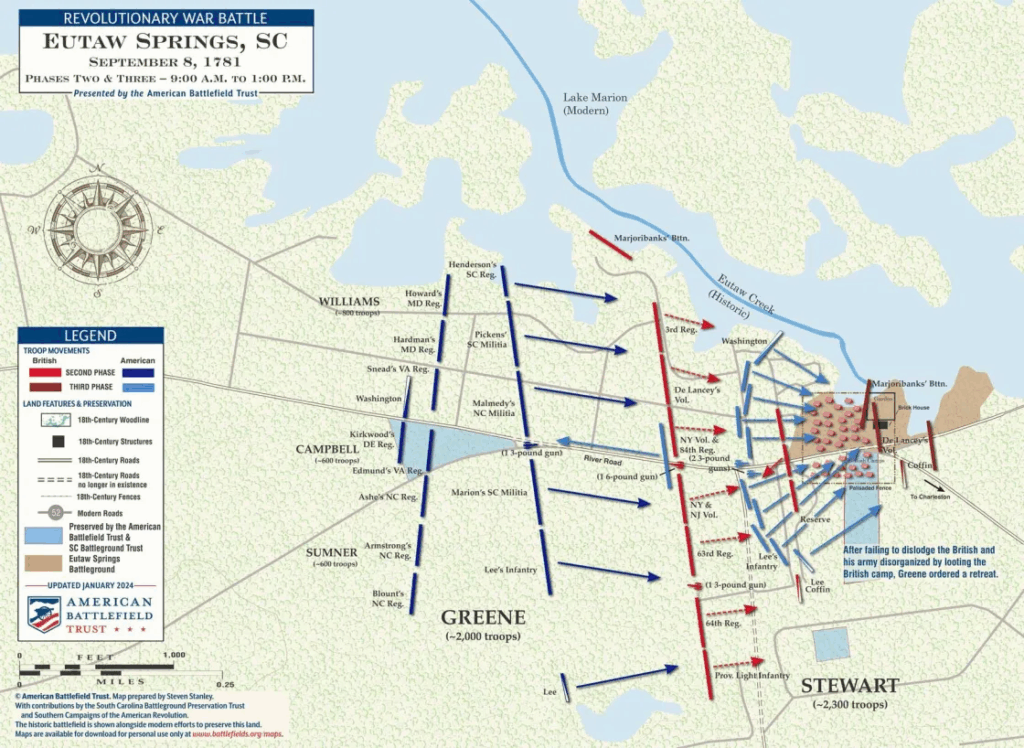
As to the claims of the two commanders:
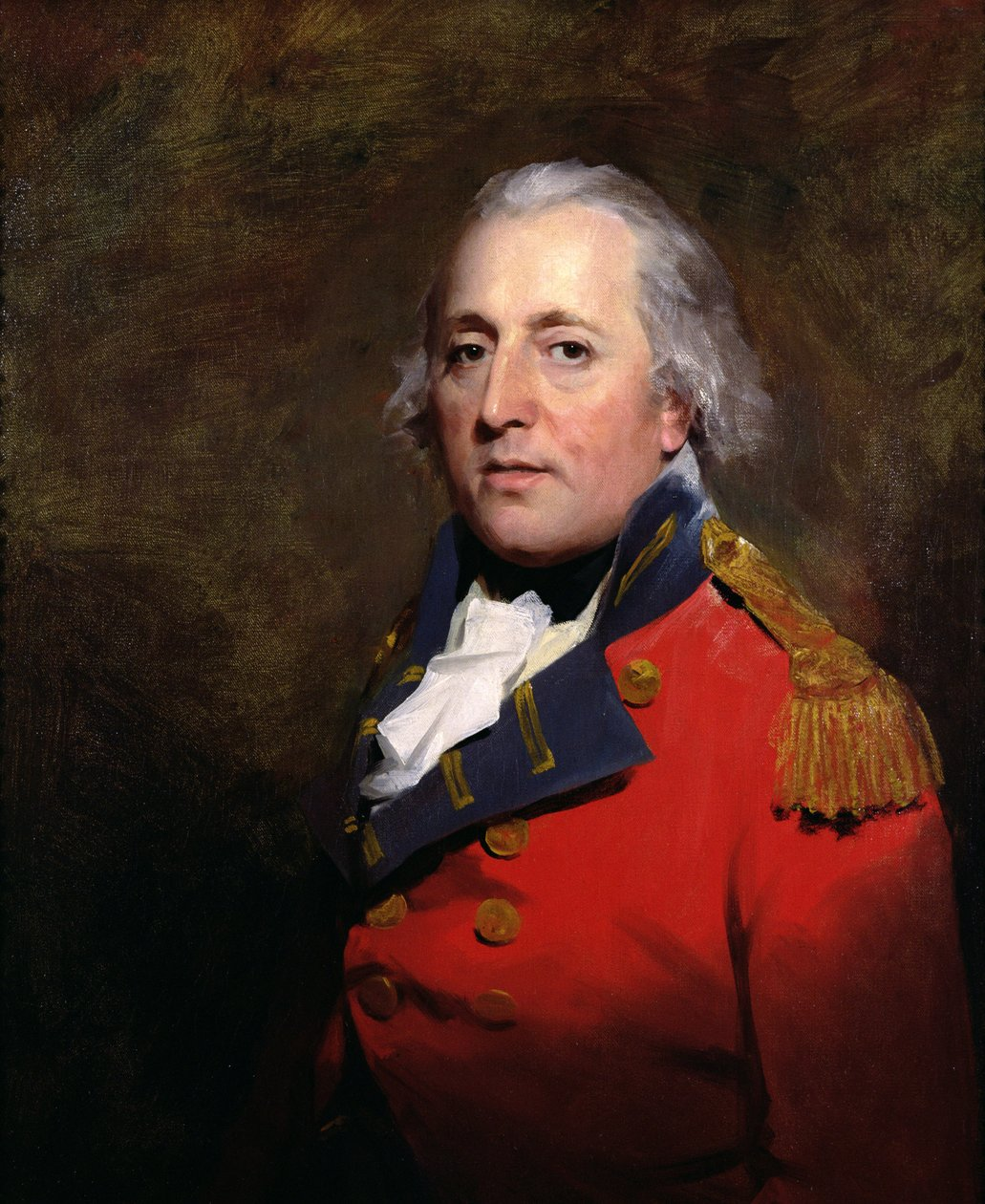
Colonel Stewart reported to General Cornwallis on September 11, 1781 that; “With particular satisfaction I have the honour to inform your Lordship, that on the 8th instant I was attacked by the rebel General Greene, with all the force he could collect in this province and North Carolina, and after an obstinate engagement, which lasted near two hours, I totally defeated him, and took two six pounders”.
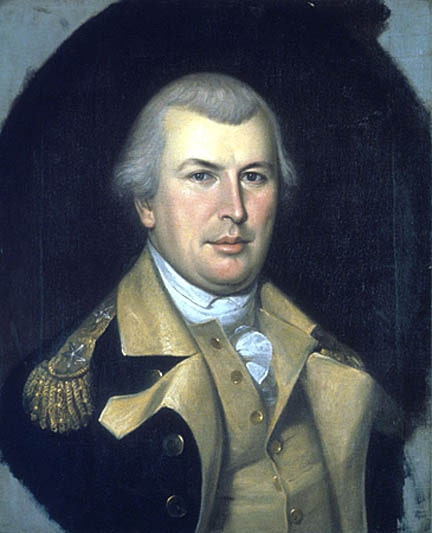
General Greene reported to General Washington on September 17, 1781 that; “By far the most obstinate fight I ever saw. Victory was ours, and had it not been for one of those little incidents which frequently happen in the progress of war, we should have taken the entire British Army”.
For a full day following the battle, neither side vacated the field and a heavy rain prevented further action, but as the British began to retire from the field towards Charleston, the British rear guard was under continual fire from Green’s troopers. As the British came within range of troops from Charleston, Greene broke off the pursuit; leaving the British to claim a tactical victory, but the reality was that it was a strategic failure.
September 12, 1781, British loyalist militia under the command of Colonels David Fanning and Hector McNeil captured Governor Thomas Burke of North Carolina. Patriot militia Brigadier General John Butler went about setting up an ambush near Lindley’s Mill the next day in an attempt to rescue the governor. Colonel McNeil died as he led the loyalists as they crossed Cane Creek in order that the loyalists be able to attack the patriot position and patriot militia Major John Nall died as he attempted to stem the loyalist crossing of Cane Creek. Both men died on the spot. The patriots were unsuccessful in their attempt to rescue Governor Burke and the governor was imprisoned on James Island.
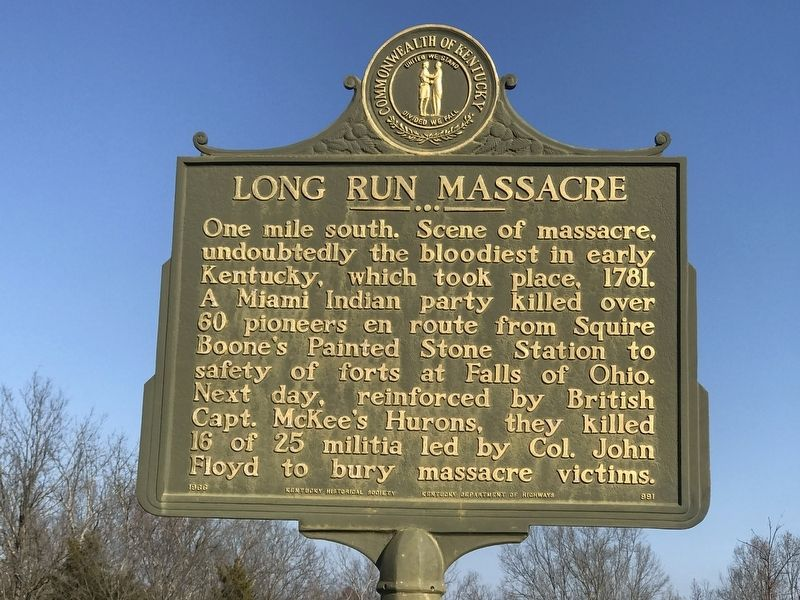
“Long Run Massacre” was the result of a large Indian raid in what is now Jefferson County, Kentucky September 13, 1781. 5 settlers were killed, the following day 17 soldiers were killed when they came to bury the settlers. During the fight that followed, a Wyandot Indian chief was killed, ending the raid as the Indians scattered, thus ending the raid by loyalist Captain Alexander McKee.
“The Siege of Yorktown, September 28-October 19, 1781 was the last major land engagement of the American Revolution. Beginning in late August, Washington and the French Lieutenant General Rochambeau began to move south towards Virginia. Washington had previously dispatched General Lafayette to shadow British General Cornwallis as he began to campaign in Virginia.
Cornwallis was ordered to begin building a deep water port for the British Navy; his engineers picked the Yorktown peninsula as the site for the port. Lafayette relayed this information to General Washington and the combined French and Continental force moved to the head of Chesapeake Bay. French Admiral de Grasse ferried the troops to a point west of Cornwallis’s position while De Grasse was able to force a naval blockade at the entry to Chesapeake Bay. British General Henry Clinton was not able to send Admiral Graves to evacuate Cornwallis, thereby sealing Cornwallis on the point of the Yorktown peninsula.
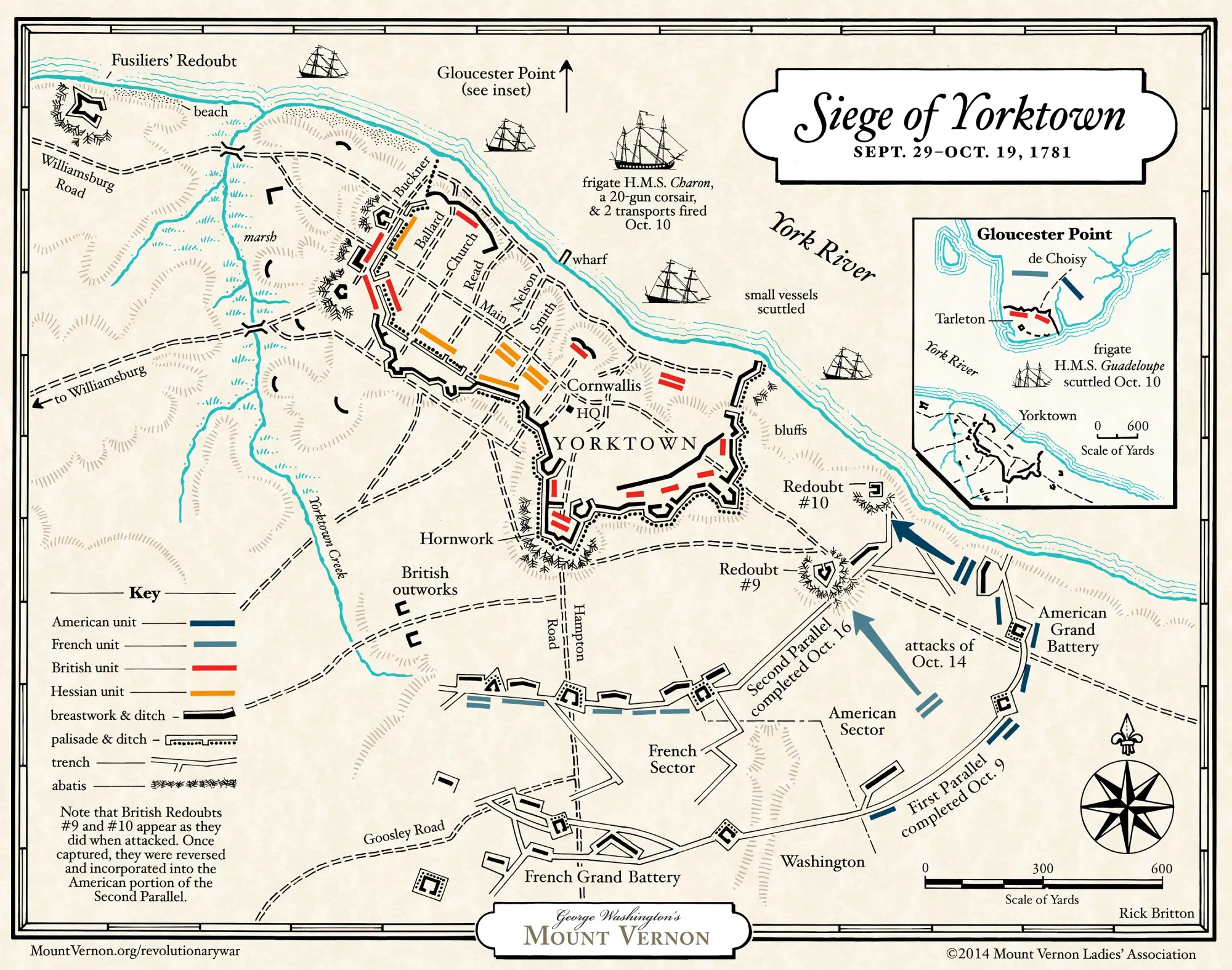
Washington and Rochambeau’s combined forces totaled 18,000 men began the job of creating a siege using French engineers to place both cannon and troops to facilitate the siege. After weeks of shelling, Cornwallis finally found himself without the necessary fire power to break the siege and was forced to surrender his army to Washington.
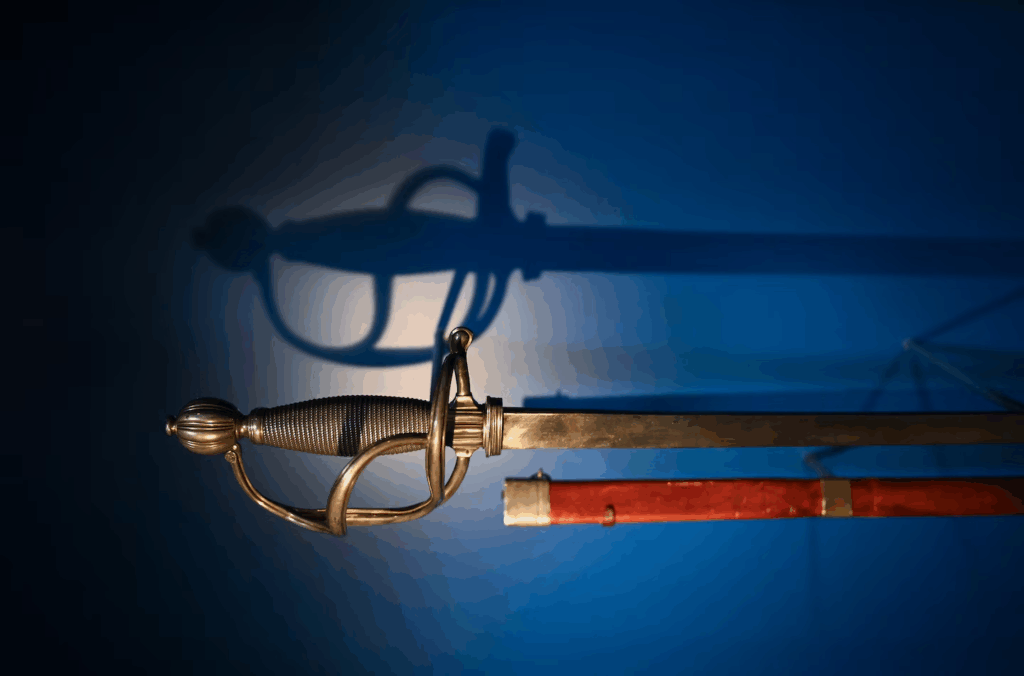
Whether feigning illness or actual illness, Cornwallis sent his subordinate, General O’Hara to surrender the 8,000 British troops to Washington and Rochambeau. O’Hara first tried to offer the surrender to Rochambeau, who refused saying that it was to Washington they had to surrender. Washington declined to accept Cornwallis’s sword and had General Lincoln who had been forced to surrender at Charleston the honor of receiving Cornwallis’s sword.
The British requested that they be allowed to march out of their positions with flags flying and bayonets fixed; Washington denied the request as General Lincoln had been denied the same request when he had to surrender Charleston to the British. At 1400 hours, October 19, 1781 the British signed the articles of surrender. In all. Some 8,000 British soldiers surrendered along with 214 artillery pieces, a number of naval transport vessels, plus many wagons and horses as well. The British were forced to lay down their arms in between the American and French forces as a sign of capitulation.
Walt Mow 2025