The Day of Days
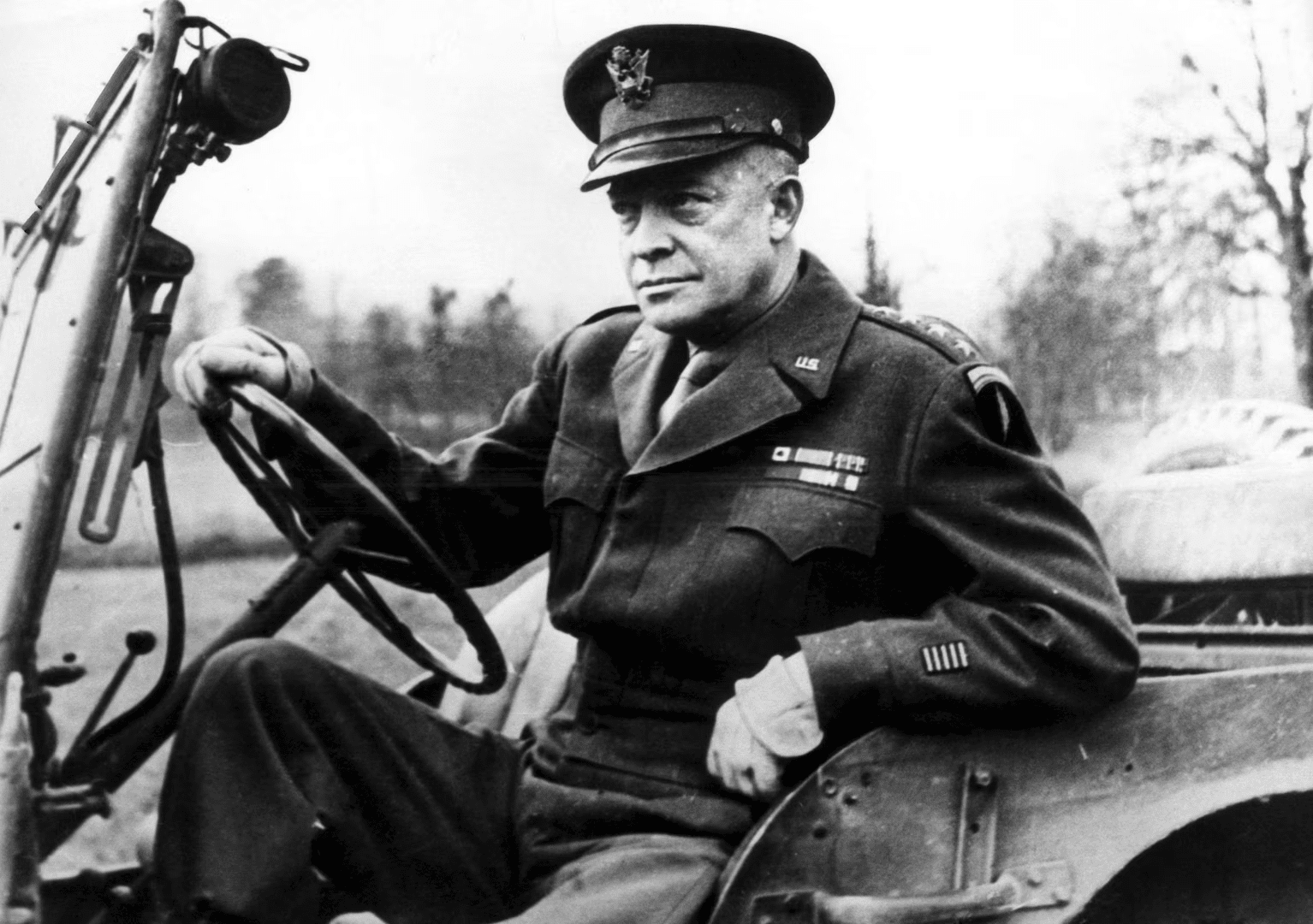
It was a cold blustery night on 4 June when Brit Meteorologist Group Captain James Stagg met with General Eisenhower at SHAEF headquarters. The bad weather had already forced a postponement of the invasion of Festung Europa and the next tide window would be two weeks away. Stagg was convinced that the weather would moderate enough to launch the invasion. Ike agreed, it was a go. The largest Amphibious operation ever undertaken would kick off 6 June 1944.
The plan included Airborne drops, glider landings and an amphibious assault in Normandy France. The weather was a key factor in the success or failure of the landings.
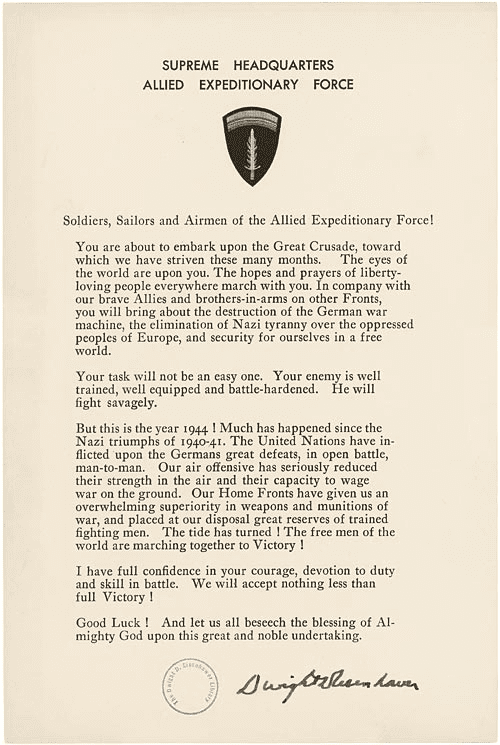
The following General Order, written by Eisenhower was given to everyone involved in Operation Overlord:
Starting at 2130 on the 5th, C-47s carrying pathfinder units for the 82nd and 101st Airborne divisions took off from airfields across southern England. The Pathfinder planes arrived over France just after midnight on June 6, and the first paratroopers made landfall at approximately 12:15 AM. Those pathfinders were supposed to guide the following waves of paratroopers to their drop zones.
The drops didn’t go exactly to plan, and yet that may have worked out better for the allies. The Germans were convinced that it was just a reconnaissance force due to the scattered nature of the drop and the reports of small units spread all over the Norman countryside. General Friedrich Dollmann, the commander in the Calais sector refused to send troops to General Hans von Salmuth because Allied deception – Operation Fortitude – convinced not only him but Generals Rommel and Von Rundstedt the next higher commanders that the Normandy operation was a feint.
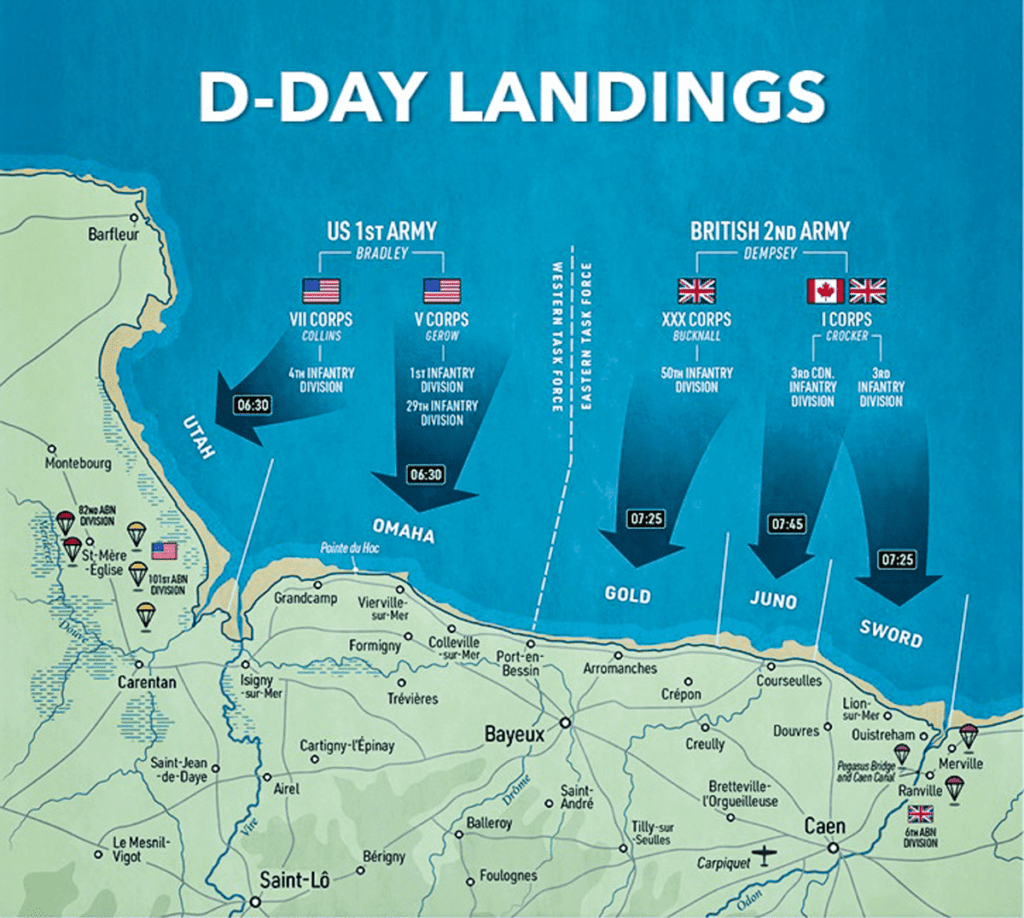
The amphibious landings did not have an auspicious start either, at least on the American beaches. The Brits and canadians hit their phase lines – a line drawn on a planning map indicating where a unit should be at a particular time or phase of a battle – pretty close to schedule. The 6th Airborne division and the Ox and Bucks landed near Ranville. Their mission was to capture the Bénouville Bridge over the Caen Canal, between Caen and Ouistreham. Major John Howard and his men took the bridge after a fierce 10 minute firefight.
The 4th and 90th Infantry divisions landing at Utah Beach did ok as well, suffering fewer than 500 casualties in the initial landings despite not hitting their landing beaches. Brigadier General Theodore Roosevelt jr was the only general to hit Utah that morning. After finding he had been landed far from his designated sector, he said “We’ll start the war from right here!” He was awarded the Medal of Honor for his actions organizing a chaotic landing and meeting most of his first day objectives.
Omaha beach where the 1st and 29th divisions and several battalions of US Army Rangers landed was a different story. The fighting there was the heaviest of all the fighting on D-Day. By the time the sun set on Omaha beach on 6 June 1944, more than 2000 soldiers and sailors had died and 3 Medals of Honor earned.
- Technician 5th Grade John J. Pinder Jr. (Posthumous): Gravely wounded in the legs while bringing a radio ashore, Pinder repeatedly exposed himself to intense fire to salvage vital communication equipment, continuing to assist his unit before being killed on his third trip into the surf.
- 1st Lieutenant Jimmie W. Monteith Jr. (Posthumous): Rallying his men under heavy shelling, Monteith led a daring assault across the open beach, organized defense against counterattacks, and was ultimately killed while trying to lead an armored breakout.
- Technician 4th Grade Carlton W. Barrett: Operating as a guide and assistant, Barrett repeatedly waded through turbulent, fire-swept waters to rescue wounded men, carry them to safety, and salvage equipment.
All day Ike waited for news that the landings were a success. Or a failure. He smoked four to six packs of unfiltered Camel cigarettes and drank 15 to 24 cups of coffee a day during the period surrounding the D-Day invasion. It caused him serious health issues including migraines, high blood pressure and insomnia.
He wrote a note on 5 June to be published in the case of a failure on the beaches of Normandy. He crumpled that note and threw it in the trash once he got the news that the invasion was successful and a lodgement had been secured. The Note was removed from the wastebasket by his military secretary and preserved.
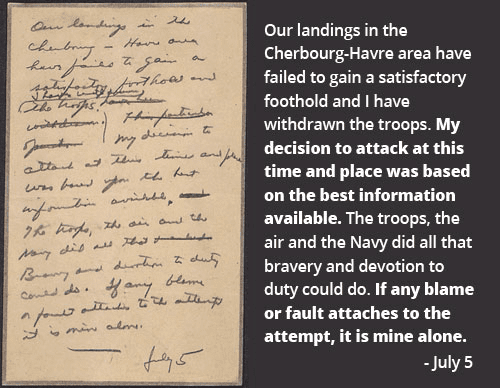
“Our landings in the Cherbourg-Havre area have failed to gain a satisfactory foothold and I have withdrawn the troops. My decision to attack at this time and place was based upon the best information available. The troops, the air and the Navy did all that Bravery and devotion to duty could do. If any blame or fault attaches to the attempt it is mine alone.”
Despite the chaos – perhaps because of it – the invasion was a success. The objectives on 4 of the 5 beaches were reached on the Longest Day. The overall objective of having a continuous beachhead from Barfleur in the west to Ouistreham in the East would take several days, but the lodgement was never in serious trouble again after nightfall on the 6th.
By the time the Operation Overlord came to a close at the end of August some 20,668 Americans 11,000 Brits, 5,021 Canadians and 2,097 Free Poles were killed and more than 225,000 of all nationalities injured. There are no truly reliable sources on German losses, but the best estimates put it at ~200,000 killed and 2o0,000 captured.
On the 40th anniversary of D-Day, President Ronald Reagan delivered one of his best speeches; The Boys of Point du Hoc. He delivered it in front of the Pointe du Hoc memorial atop the cliffs of Pointe du Hoc. In attendance were 62 survivors of the battle. Reagan referred directly to them in his speech: